Tuesday, September 30, 2014

Bob Parker (1915-1998)

Robert D. "Bob" Parker was born on August 8, 1915, in Indiana and lived in Fort Wayne as a boy and for most if not all his life. He worked as a photographer and commercial artist, but Bob Parker gained his fame by drawing baseball cards. Unfortunately, I know little else about his life or work. Bob Parker died on May 3, 1998.


Text copyright 2014, 2024 Terence E. Hanley

Friday, September 5, 2014

Hoosiers in Art-Aviators

Hoosiers have contributed to aviation in America from the beginnings of powered flight. Although Orville Wright (1871-1948) was a native Ohioan, his older brother Wilbur Wright (1867-1912) was born in Indiana, in the Henry County village of Millville. The Wright Brothers have been commemorated on many postage stamps. Here's one from Romania.

And another from Ivory Coast.

Octave Chanute (1832-1910) corresponded with the Wright Brothers and encouraged them in their efforts. Born in France and a resident of Chicago, Chanute conducted tests of gliders at Miller Beach, Indiana, in the 1890s. The portrait here is by Milton Caniff, famed cartoonist on Terry and the Pirates and Steve Canyon.

World War I ace Eddie Rickenbacker (1890-1973) was, like Orville Wright, born in Ohio, but from 1927 to 1945, he owned the Indianapolis Motor Speedway. This image is from a series of trading cards called "Sky Birds," from 1933-1934, as are the following five images.


Amelia Earhart (1897-1937?) was born in Atchison, Kansas. In 1935, she joined the faculty of Purdue University as a counselor and adviser. The Purdue Research Foundation paid for the Lockheed Electra in which she was flying when she disappeared over the South Pacific in 1937.


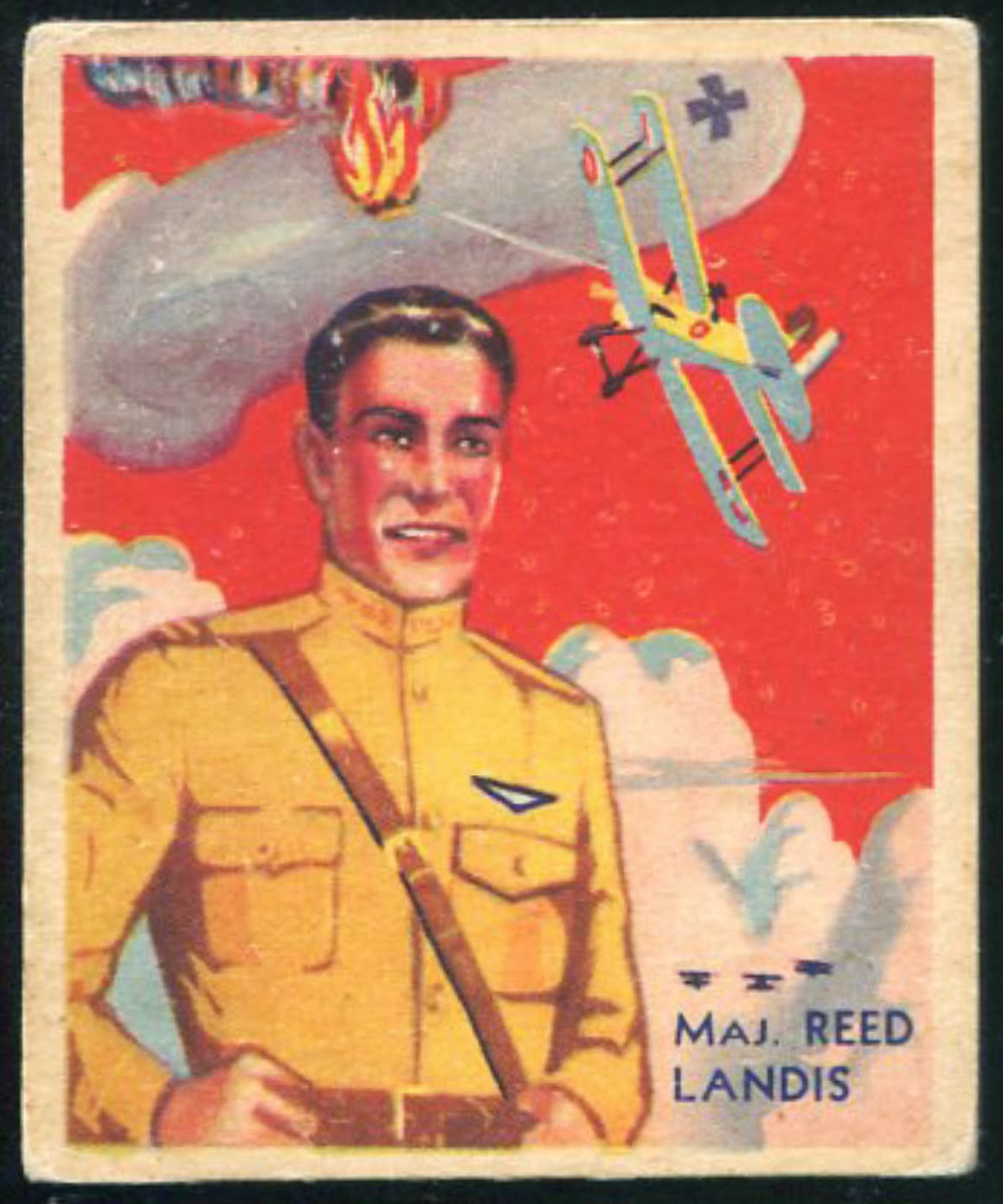
In the category of "Almost a Hoosier" comes Major (later Colonel) Reed Landis (1896-1975), son of Kenesaw Mountain Landis (1866-1944), a commissioner of baseball and federal judge who lived in Indiana and practiced law there as a young man. Reed Landis was born in Ottawa, Illinois, and served in the United States Signal Corps during World War I.


Francis "Gabby" Gabreski (1919-2002), the leading American ace of World War II, was born in Pennsylvania, but matriculated at the University of Notre Dame, where he became interested in aviation. The art is once again by Ohioan Milton Caniff.

Unlike his contemporary, Gabby Gabreski, Tom Harmon (1919-1990) was born in Indiana (in Rensselaer) and attended school out of state. He won the Heisman Trophy at the University of Michigan. In 1942, he enlisted in the U.S. Army Air Corps and served in China. Harmon was awarded the Purple Heart and the Silver Star. The image here is from his NFL rookie card from 1941. 

Captions copyright 2014, 2024 Terence E. Hanley

Thursday, August 28, 2014

Indiana Bison-tennial!

We're still a year and a half away from the beginning of Indiana's bicentennial year, but I would like to be among the first to make the connection between that celebration and the Indiana State Seal, which includes the image of an American bison, and to say:

Happy Bison-tennial, Indiana!

The Seal of the State of Indiana, a design proposed before Indiana was a state. Only two other states--Kansas and North Dakota--include the image of a bison on their state seals. Both were admitted to the Union after Indiana. That will make the Hoosier State the first to observe a bison-tennial. By the way, whoever designed the seal is a candidate for the first illustrator to call Indiana home.

Update (Mar. 30, 2015): As it turns out, I was not the first to make the connection between the state seal and the bicentennial, but my wishes are the same. Also, there are some who believe that William Henry Harrison created the seal, modified from the original seal of the old Northwest Territory.

Text and caption copyright 2014, 2024 Terence E. Hanley

Wednesday, August 27, 2014

Hoosiers in Art


A cartoon by Art Young (1866-1943) showing types from the World's Columbian Exposition, also known as the Chicago World's Fair of 1893. In the upper left, lounging on a wooden chair, is what seems to be the simplest among them. According to the caption, he is "A Posey County Type on the Veranda of the Indiana Building."

Posey County is the southwestern-most county in Indiana and home of the New Harmony Utopian community of the early nineteenth century. It's the only county in Indiana that touches both the Wabash River and the Ohio River. I have never been there, but I imagine that the farming is good and that the timber is almost southern in character and composition. (Indiana by the way is the only state in which our two deciduous conifers are both native. Baldcypress, a southern tree, is found in Posey County. Larch, or tamarack, calls the northern part of the state home.)

Unfortunately for Art Young, he was not born a Hoosier. He was instead native to Illinois. Young worked for the Chicago Daily Inter Ocean early in his career and created this cartoon for the paper's color section. New York newspapers get a lot of attention because of their color Sunday comics--Hogan's Alley (The Yellow Kid), Buster Brown, and so on--but the Chicago Inter Ocean was the first American paper to print in color. This cartoon gave me the idea for today's posting. It's only right that it should come first.

A cartoon by a native-born Hoosier who was transplanted out of state, and referring to a cartoon by a non-native who was transplanted to Indiana. The native was Cyrus Cotton Hungerford (ca. 1889-1983), aka Cy Hungerford, a newspaper cartoonist in Parkersburg, West Virginia, and more famously, in Pittsburgh, Pennsylvania. Hungerford was born in Manilla, Indiana, not far from my home. He left Indiana early on but returned there for eternal rest. This cartoon, from fifty-seven years ago this month, refers to Toonerville Folks, also called Toonerville Trolley, drawn by Fontaine Fox (1884-1964). Fox was born in Louisville, Kentucky, but matriculated at Indiana University. That's where you will find his collection of original cartoons as well.

It's time for the county fair all over America, and children are carefully showing their livestock and poultry like the girl in this painting by Norman Rockwell from 1947-1948. Times have changed and clothing, too, but you might still see people like this at the 4-H fairgrounds this month. (Note the 4-H shamrock on the papers under the girl's arm.) Every one of them is a Hoosier.

In 1947, Norman Rockwell (1894-1978) made a trip to Jay County, Indiana, to take pictures of the Steed family and their neighbors. The artist used those pictures as references for his painting "The County Agent," published in The Saturday Evening Post in 1948. From left to right, the people in the painting are Don Steed of Redkey; Mr. Steed's daughter Jama; Jay County Extension Agent Harold Riby (or Herald K. Rippey--I'm not sure as to the correct spelling); Larry and Sharon Lear or Steed (again, not certain); Mr. Steed's wife Martha; and hired hand Arlie Champ.
James Whitcomb Riley (1849-1916), a portrait by T.C. Steele (1847-1926). Born in Greenfield, Indiana, Riley was known as the Hoosier Poet and the Hoosier Bard. Steele was the leading artist in the renowned Hoosier Group of the late 1800s and early 1900s. This painting is from 1891. Riley was then in his early forties, and the artist had not many years before returned from studies in Germany. The dark palette and careful brushwork indicate a German influence. Steele's landscapes, for which he known, are much more colorful and impressionistic.

Here is a later portrait of Riley by John Singer Sargent (1856-1925). The palette is still dark, but there are rosy tones in the subject's face and hands, and his tie is red. Sargent was trained in France; he is known for his quick, loose, and impressionistic brushwork. Of the two, I believe this to be the more successful portrait. Nonetheless, T.C. Steele was a very fine artist.

Here is the Hoosier Poet on a smaller scale: a U.S. postage stamp from 1940.

I believe this to be a picture of Gene Stratton Porter (1863-1924), author of A Girl of the Limberlost and Freckles, but the source on the Internet does not describe or identify the painting, nor does it give the name of the artist.

"The Underground Railroad" by Cincinnati artist Charles T. Webber (1825-1911). Painted in time to be displayed at the World's Columbian Exposition of 1893, "The Underground Railroad" shows Levi Coffin (1798-1877) and his wife Catherine White Coffin at their work. The Levi Coffin home in Fountain City, Indiana, is a National Historic Landmark.

"The Canal: Morning Effect" by Richard Buckner Gruelle (1851-1914), a member of the Hoosier Group and father of a family of artists in Johnny, Prudence, and Justin Gruelle. The view (from 1894) is of the Indiana Statehouse, and beyond that, of the Indiana Soldiers' and Sailors' Monument in Indianapolis. There is in fact a Hoosier in the painting, a woman wearing a red hat. I saw an image of this painting years ago and I have never forgotten it. It came from a self-taught artist. The canal in the picture is just west of Downtown. My grandfather's brother drowned in its waters at the age of four more than one hundred twenty years ago.

A statue of a Doughboy from a cemetery in Monroe County, Indiana. One hundred years ago this summer, the world went to war. America sent hundreds of thousands to men to the Western Front after entering the war in 1917. They proved decisive in victory for the Allies. Hundreds of thousands were also killed, wounded, or died of non-combat injuries or disease. In 1918-1920, the Spanish flu killed tens of millions of people all over the world. When I see a death date of 1919 for a young person in the United States, I can't help but think it was because of the flu. The Riddle brothers, one of whom may be depicted in the statue shown here, may very well have died of the disease that so ravaged the world.

If you go to Monroe County, or Lawrence County, or places close by in Indiana, you will see much that is made of limestone, including the statue of Joe Palooka at Oolitic. Joe Palooka was created by the cartoonist Ham Fisher (1900 or 1901-1955), a Pennsylvanian by birth but also a traveling salesman. He is supposed to have sold Joe Palooka the comic strip first to the Indianapolis Star. Whether that story is true or not, Fisher seems to have had a soft spot in his heart for the Hoosier State. On June 14, 1948, he was on hand to dedicate the Joe Palooka statue at its original location. (It was later moved to Oolitic.) Near Oolitic is the quarry where the limestone used in the Empire State Building was cut.

Johnny Appleseed (1774-1845) came to Indiana late and life. He died there and was buried there, in or near Fort Wayne in 1845.

Edward Eggleston (1837-1902) wrote The Hoosier Schoolmaster, one of the most popular of nineteenth century novels. It was adapted to this children's version in the 1940s. The cover illustration is unsigned. In 1812, my family came over from Kentucky into Jefferson County, Indiana, about where Eggleston's book is set. Maybe those are little Bear children running around the school.

Speaking of little bears, here is a picture of the kidnapping of Frances Slocum (ca. 1773-1847), which took place in Pennsylvania in 1778. Frances, renamed Mo-con-no-quah (translated as Young Bear or Little Bear), was removed to Indiana, grew up in the Delaware Indian tribe, and married a Delaware man. In 1837, she was reunited with her family, but she decided not to return to them. Instead she lived out her life in Indiana, a place named for her people.

Mo-con-no-quah in adulthood. The portrait is signed. It appears to be the same signature as in the image above.

O-Saw-Se-Quah (or O Sha Se Qua), Frances Slocum's daughter, a drawing that is perhaps also by the same artist. (Note the distinctive B in the lower right corner. The date appears to be 1904.) American Indians were the first Hoosiers. I'll close with the image of a woman who was descended from them and from the white settlers who displaced them. 

Captions copyright 2014, 2024 Terence E. Hanley

Thursday, July 31, 2014

Abraham Lincoln in Indiana

Abraham Lincoln was born in Kentucky and lived as an adult in Illinois, but his formative years were spent in what is now Spencer County, Indiana. Young Abe arrived in Indiana in the autumn of 1816, not long before the territory became a state. He was then just seven years old. When he was nine, Abe's mother died of milk sickness, a mysterious disease we now know is caused when cow's milk is poisoned by white snakeroot. Abraham Lincoln of course went on to be a lawyer, a U.S. representative, and, as the first Republican president, the Great Emancipator and the savior of the Union. He wrote: "All that I am or hope to be, I owe to my angel mother--blessings on her memory." Nancy Hanks Lincoln lies buried in Hoosier soil, near her home on Little Pigeon Creek.

I recently found three books on Indiana history and Abraham Lincoln. I would like to show three illustrations from those books, each by an illustrator previously unknown to me either as an illustrator or by name. Two have birthdays coming up next month.

"A Typical Pioneer Scene" by the Brown County artist Marie Goth. Born in Indianapolis on August 15, 1887, Jessie Marie Goth was educated at Manual Training High School and the Herron School of Art in her home city. Her teachers included fellow Hoosiers William Merle Allison, Harry E. Wood, and William Merritt Chase. Marie also taught art, but she is best known for her portraits. She was in fact the first woman to paint an official portrait of an Indiana governor (Henry F. Schricker). Her younger sister Genevieve, also an artist, married an artist, Carl C. Graf. Marie Goth was otherwise connected by blood or association with artists of the Hoosier Group and among the artists' colony in Brown County, Indiana. Her longtime companion was the artist Veraldo J. Cariani (1891-1969).

The drawing here is from Historic Indiana by Julia Henderson Levering (1916). In his youth, Abraham Lincoln would have lived in a cabin like this one. He also worked on a ferry boat and a flatboat, making a trip to New Orleans in the 1820s. In 1830, he moved with his family to Illinois, leaving his Indiana home behind. By coincidence, Marie Goth lived in a log house in Brown County. She, too, fell victim to poison when she was bitten by a brown recluse spider in the autumn of 1974. In her weakened state, she fell down the steps of her home and died on January 9, 1975.

In 1927, The Indiana Lincoln Union put out a booklet called Lincoln the Hoosier, written by Charles Garrett Vannest and illustrated by a youthful Constance Forsyth. Born in Indianapolis on August 18, 1903, Constance Forsyth was the daughter of artists Alice Atkinson Forsyth and William Forsyth. Like her father, Constance was renowned as a painter and teacher. Her résumé runs to hundreds of items (education, exhibitions, prizes and honors, holdings in museums, teaching career, etc.). One highlight of her career was her assistance to Thomas Hart Benton in his completion of the murals for the Indiana Building at the Century of Progress Exposition, the Chicago World's Fair of 1933. Lincoln the Hoosier was the first of two books she illustrated, the other being The Friends by Esther Buffler (1951). Constance Forsyth died on January 22, 1987, in Austin, Texas.

This map of Lincoln home sites is in a second booklet called Abraham Lincoln: A Concise Biography, published in 1934 by the Lincoln National Life Insurance Company of Fort Wayne. The mapmaker was Noble Brainard, also of Fort Wayne. (The image reproduced in the booklet shows only part of Brainard's original design. The image above is from the Internet.)

Noble Eyck Brainard was born on September 3, 1893, in Buda, Illinois. Like Marie Goth and Constance Forsyth, he was a teacher. For a time he lived in New Mexico, but he also worked as a civil servant in the Philippines and in Fort Wayne, where he resided from the 1920s on. Brainard married Amelia Zichgraf in 1924 in Fort Wayne. The copyright date on the map above is 1933. Brainard died on October 28, 1956, and is buried in his adopted home city. For years, Fort Wayne was home to the Lincoln Museum, one of the largest collections related to Abraham Lincoln in the United States. In 2008, shortly before Abe's bicentennial, the Lincoln Financial Foundation, holder of the collection, donated it to the Indiana State Library and the Allen County Public Library.

Text and captions copyright 2014, 2024 Terence E. Hanley

Tuesday, July 1, 2014

Independence Day!

"The Glorious Fourth at Yapp's Crossing" by John B. Gruelle (1880-1938) of Indianapolis, from Judge magazine, circa 1910.
"Particle of Smoke, Containing Fourth of July Microbe, Highly Magnified" by Harvey Peake (1866-1958) of New Albany, also from Judge, circa 1910.
The cover of We Love America by Josephine van Dolzen Pease (1951) and illustrated by Esther Friend (ca. 1907-1991) of Indianapolis.
A scene from the Revolutionary War in Vermont, drawn by Roy Frederic Heinrich (1881-1943) of Goshen, Indiana, taken from The White Mountain Scrap Book by Ernest E. Bisbee (1946), originally from Heinrich's series for the National Life Insurance Company of Montpelier, Vermont.

An illustration showing the surrender of General John Burgoyne at Saratoga, October 17, 1777, by Frederick Coffay Yohn (1875-1933) of Indianapolis. Burgoyne's surrender took place more than a year after the first Independence Day, but it proved a turning point in the Revolutionary War and helped assure that we would soon be free of tyranny.

May we forever be so free.

Happy Independence Day, America!

Captions copyright 2014, 2024 Terence E. Hanley

Monday, June 30, 2014

James E. Taylor (1839-1901)

James Earl Taylor was born on December 12, 1839, in Cincinnati, Ohio. His widowed mother moved her family to Indiana when he was young. Taylor graduated from the University of Notre Dame at age sixteen. At eighteen, he painted a panorama of the Revolutionary War, which was exhibited throughout the western states, what we now call the Midwest. Taylor returned to the city of his birth, but in 1860, he relocated to New York City to study art. When the Civil War came, he enlisted in the 10th New York Volunteers of National Zouaves, one of the units known for its colorful and exotic uniforms. Taylor served two years and rose to the rank of sergeant. Rather than reenlist, he was persuaded to apply for a position as a special artist, what we would call a combat artist. Thus James E. Taylor went to work for Frank Leslie's Illustrated Newspaper. Assigned to Philip Sheridan's army, Taylor took part in the Shenandoah Valley campaign, then campaigns in eastern Virginia and the Carolinas, finally to arrive on horseback in the Confederate capital of Richmond at the close of the war. Afterwards, Taylor drew pictures of the American South and West, where he earned the title "The Indian Artist." He continued with Leslie's until 1883, thereafter working as a freelance artist. Taylor also created illustrations for Frank Leslie's Boys' and Girls' Weekly for children. James E. Taylor died on June 22, 1901, in New York City.

James E. Taylor was the subject of an article in American Heritage in 1980 (“War Correspondent: 1864" by Oliver JensenAmerican Heritage, Vol. 31, No. 5 [August–September 1980]: 48–64.) His book, With Sheridan Up the Shenandoah Valley in 1864: Leaves from a Special Artist's Sketch Book and Diary, was not published until 1989, and then only in a rare edition. Taylor also illustrated Colonel Richard Irving Dodge's memoir Our Wild Indians: Thirty-three Years' Personal Experience Among the Red Men of the Great West (1882).

A drawing by James E. Taylor of the Florence Prison Stockade, a Confederate prison camp located near Florence, South Carolina. Note the date--1897--indicating that the artist recreated this scene more than thirty years after the fact.
"Heroic Death of Walter Kennedy," drawn by Taylor (1874), an image from his own scrapbooks, held by the Smithsonian Institution National Museum of Natural History. 

Text and captions copyright 2014, 2024 Terence E. Hanley