Showing posts with label Indiana Bicentennial. Show all posts

Tuesday, December 13, 2016

Firsts in Indiana Art-Part Two

The First Known Artist in Indiana--According to author Fred D. Cavinder in his compilation The Indiana Book of Records, Firsts, and Fascinating Facts (1985), "the earliest art on record in Indiana" is a wash drawing made by Governor Henry Hamilton of a rock formation along the Wabash River near what is now Logansport. Mr. Cavinder gives the year of composition as 1777. What must surely be the same work is shown in Mirages of Memory: 200 Years of Indiana Art, Volume I (1977), a catalogue of an exhibition from 1976-1977. That catalogue states that Hamilton composed his picture in 1778 rather than in 1777. Here are some details:
     In October of 1778, Hamilton led an expedition of about 230 men southwest from Detroit to Fort Sackville [located in Vincennes in what is now Indiana], then in the hands of colonist sympathizers. The troops travelled by canoe, carrying a heavy load of provisions and arms. The journey was a backbreaking two-and-one-half month struggle with swampy portages, rapids, rain, snow, and accidents. During this time, Hamilton kept an extensive journal documenting the campaign and made a number of sketches directly from the landscape.
     The work included in the exhibition, Shiprock, Wabash River (no. 21), does not appear to be far removed from the military tradition of factual representation. The military man's eye for details is also revealed in Hamilton's journal entry concerning this location. His careful descriptions, in text and sketch, allowed later generations to recognize the exact location of the scene which is near present-day Logansport.
     The sketch of the shiprock reveals that Hamilton understood pictorial representation. The work was done by a man who obviously grasped the principles of design and space, and who was familiar with landscape traditions. This suggests that Hamilton's work was more than a military record. [p. 20]
In other words, Governor Hamilton's drawing may have been more than a mere tool; it may also have been a work of art, and because it no longer has any military or topographic utility, Shiprock, Wabash River may exist now only as a work of art, or at the very least as a historical document. I should add this unequivocal sentence from later in Mirages of Memory: "[Shiprock, Wabash River, 1778] is the earliest known drawing produced in the area now known as Indiana," very likely the source of Fred Cavinder's information. (p. 55) The original source for both accounts may have been Wilbur D. Peat's seminal Pioneer Painters of Indiana (Art Association of Indianapolis, 1954).

There were Europeans in Indiana before Henry Hamilton. The earliest visitors were explorers, traders, and military men, but by the early eighteenth century, there were trading posts or small settlements as well. Again, it seems likely to me that there were artists among the earliest European visitors to Indiana, even if all they drew were maps. We'll have to go with what we have, though, and call Henry Hamilton the first known artist in Indiana, meaning, more precisely, the first artist to create a work of art in what is now Indiana. We can also call him the first watercolorist and the first creator of a landscape in the state. The irony is that Hamilton was a villain in Indiana, a man known as the "Hair-buyer General" for his alleged policy of buying the scalps of white settlers from the Indians who took them. Luckily for us, George Rogers Clark put Hamilton in his place by capturing Fort Sackville and Hamilton himself in 1779.

Shiprock, Wabash River, 1778, by Henry Hamilton, a drawing of 8-3/8 x 10-3/4 inches, drawn in pencil, wash, and ink, and the first known work of art created in what is now Indiana, from Mirages of Memory: 200 Years of Indiana Art, Volume I (University of Notre Dame, 1977).
a
The Fall of Fort Sackville by Frederick Coffay Yohn of Indianapolis, a canvas completed in 1923 and later adapted to a commemorative U.S. postage stamp on the sesquicentennial of the event. There are counties in Indiana named Clark and Hamilton. Clark County is named of course for George Rogers Clark, shown here on the left. Hamilton County is not named for Henry Hamilton, however, the figure on the right. Note that Clark and his men are rough, informal, and common, while Hamilton and his men are upright and dressed in finery. This image encapsulates, I think, the idea of America, of the people fighting for and securing their rights against arbitrary--and elitist--power.
a
Text and captions copyright 2016, 2024 Terence E. Hanley

Sunday, December 11, 2016

Firsts in Indiana Art-Part One

Today, December 11, 2016, is the two-hundredth birthday of the great State of Indiana. In observance of the Indiana Bicentennial, I would like to begin a series on firsts in Indiana art, a series to carry through to the end of the birth month and birth year of the Hoosier State. My sources will include those listed on a new page called "Bibliography," accessible by clicking on tabs on the right and at the top of this page. I invite additions, corrections, and speculations to and on this list of Firsts in Indiana Art.

The First Artist in What Is Now Indiana--No one knows who was the first artist in what is now the State of Indiana, for that person's name or identity is lost in prehistory. (From here on out, I'll shorten "What is now Indiana" to just "Indiana.") According to various sources, the first people in Indiana were of the Paleo-Indian Period (or Tradition) of 8000 to 6000 B.C. These are believed to have been wandering hunters in pursuit of big game. They left behind them expertly made fluted points of chert and chalcedony, artifacts of an obviously utilitarian purpose but of an equally obvious aesthetic quality. These were tools, however, and not specifically works of art.

The Paleo-Indian Period was followed by the Archaic or Meso-Indian Period (or Tradition) of 4000 to 2000, 1000, or 400 BC, depending on which source you consult. Indians of the Archaic Period are also supposed to have been wanderers. They made points of stone, too, but the artifacts most closely associated with them are shell mounds or middens, the castoff remains of freshwater mussels hunted or harvested for their meat. I should point out that the harvesting of mussels for mother-of-pearl buttons and other items, as well as for freshwater pearls, was a craze in Indiana during the early twentieth century. I think it extremely likely that American Indians of the Archaic Period would have recognized the potential for making decorative items from mussel shells and pearls, too. In fact, archaeologists have found shell (and copper) beads in graves dating from the Archaic Period in Indiana. Whether these were the earliest decorative or artistic rather than simply utilitarian artifacts in Indiana is, by my sources, an unanswered question.

The Woodland Indian Period (or Tradition), which ended with European contact, was marked by the development of agriculture and permanent and semi-permanent settlements, among other advances. In his booklet An Introduction to the Prehistory of Indiana (Indiana Historical Society, 1983), James H. Kellar was more explicit: "The Woodland Tradition is basically defined by the presence of pottery containers with surfaces distinguished by cord impressions or other decorations applied using a flat paddle-like tool." (p. 35) Note the word decorations. A roughened surface makes a pot or container easier to handle. (My supposition.) It's a short step from a roughened surface--a utilitarian development--to a decorated roughened surface--an aesthetic or artistic development. In any event, with pottery-making came a surface upon which decorations--art--could be made and which might survive into the historical period, including to the present day.

It's safe, then, to say by the archaeological record that the first artist in Indiana was probably from the Archaic Period, certainly by the time of pottery-making in the Woodland Indian Period, in which case that artist may very well have been a woman. Being an artist, I would go further than that. The people of the Paleo-Indian Period were people--they were human beings. One defining characteristic of us as human beings is our creativity, not just for solving problems in everyday life but also for expressing ourselves and for communicating what we apprehend about the world and about ourselves and our existence. With that in mind, I feel confident in saying that the first artist in Indiana was among the first people in Indiana, setting foot here 10,000 or more years ago.

Late Paleo Indian-Early Archaic Blades, presumably from the period 8000 BC and after, from An Introduction to the Prehistory of Indiana by James H. Kellar (Indianapolis: Indiana Historical Society, 1983), p. 28. Fluted points are among the earliest surviving artifacts of people in Indiana. Although strictly utilitarian in nature, they have an undeniable aesthetic quality. Their production would have required a combination of technological innovation, manual dexterity, and visualization of an ideal, all requisite for the creation of art. Is there any reason to believe that Paleo Indians would not also have created works of art?

Middle Woodland Pottery, presumably from the period 1000 B.C. to 1000 A.D., from the same booklet (p. 45). Here are obvious works of art, a clay figurine that does not appear to have had a utilitarian purpose, and the decorative surfaces of clay pots. Having done only a cursory search for cave painting in Indiana, I can't say that there is any known art of that type in the state. Nonetheless, pottery, though not two-dimensional, offered early Indians a surface upon which they could create decorations. It's no surprise that their decorations would take the form of patterns imposed upon, if not recognized in, nature.

Text copyright 2016, 2024 Terence E. Hanley

Wednesday, August 3, 2016

Mac Heaton Art Gallery

This year--this month in fact--is the centennial year of the establishment of the National Park Service (NPS), a milestone in the history of conservation in America. Two thousand sixteen is also the bicentennial year of the State of Indiana. Lost in those two big celebrations is the fact that 2016 is also the centennial year of the first state parks in Indiana, acquired through the tireless efforts of Richard Lieber (1869-1944). McCormick's Creek State Park, located in Owen County, was Indiana's first. Turkey Run State Park, located in Parke County and Colonel Lieber's favorite, came next. Both were dedicated on December 16, 1916, in conjunction with the centennial celebration of Indiana statehood. A little more than two years later, in March 1919, the governor signed a bill creating the Indiana Department of Conservation. Colonel Richard Lieber was named the first director. In 1965, the Indiana Department of Conservation was renamed the Indiana Department of Natural Resources (IDNR). The agency still bears that name.

The Department of Conservation began publishing a magazine called Outdoor Indiana in February 1934. In this age when magazines seem to be dying, Outdoor Indiana is still in print. In June 1945, artist Malcolm C. Heaton (1925-2002) went to work for Outdoor Indiana. In time he became art director of the Department of Conservation. Nicknamed Mac, Heaton was a versatile artist, as the illustrations below will show. He was adept at painting, drawing, and even cartooning. He worked at a time when state conservation agencies employed some outstanding wildlife artists, including Charles Schwartz (1914-1991) in Missouri, Bob Hines (1912-1994) in Ohio, and Ned Smith (1919-1985) in Pennsylvania. Mac Heaton stood among them as an artist from what might be called the golden age of conservation in America.

"Cornfield Covey" by Mac Heaton, a painting depicting a river-bottom field in Greene County, the artist's home county, for the November 1963 issue of Outdoor Indiana. Unfortunately, despite all the efforts of conservationists, a covey of bobwhite quail has become a rare sight in Indiana.

A drawing of a gull by Heaton, showing that he worked just as well in halftone as in full color. This illustration is from an article called "Gulls of Michigan City" by James Landing, from Outdoor Indiana, August 1963.

On March 22, 1824, seven white men murdered nine American Indians near Pendleton, Indiana, in an event now called the Fall Creek Massacre. The men were tried and some were executed for their crimes. It was the first time in American history that a white man was executed for a crime against an Indian. Outdoor Indiana had an article about the massacre in its August 1963 issue. The author was Arville L. Funk. Mac Heaton provided the illustration.

In addition to being an illustrator, Heaton was a cartoonist. Here is one of his cartoons, from the back cover of Outdoor Indiana, February 1964.

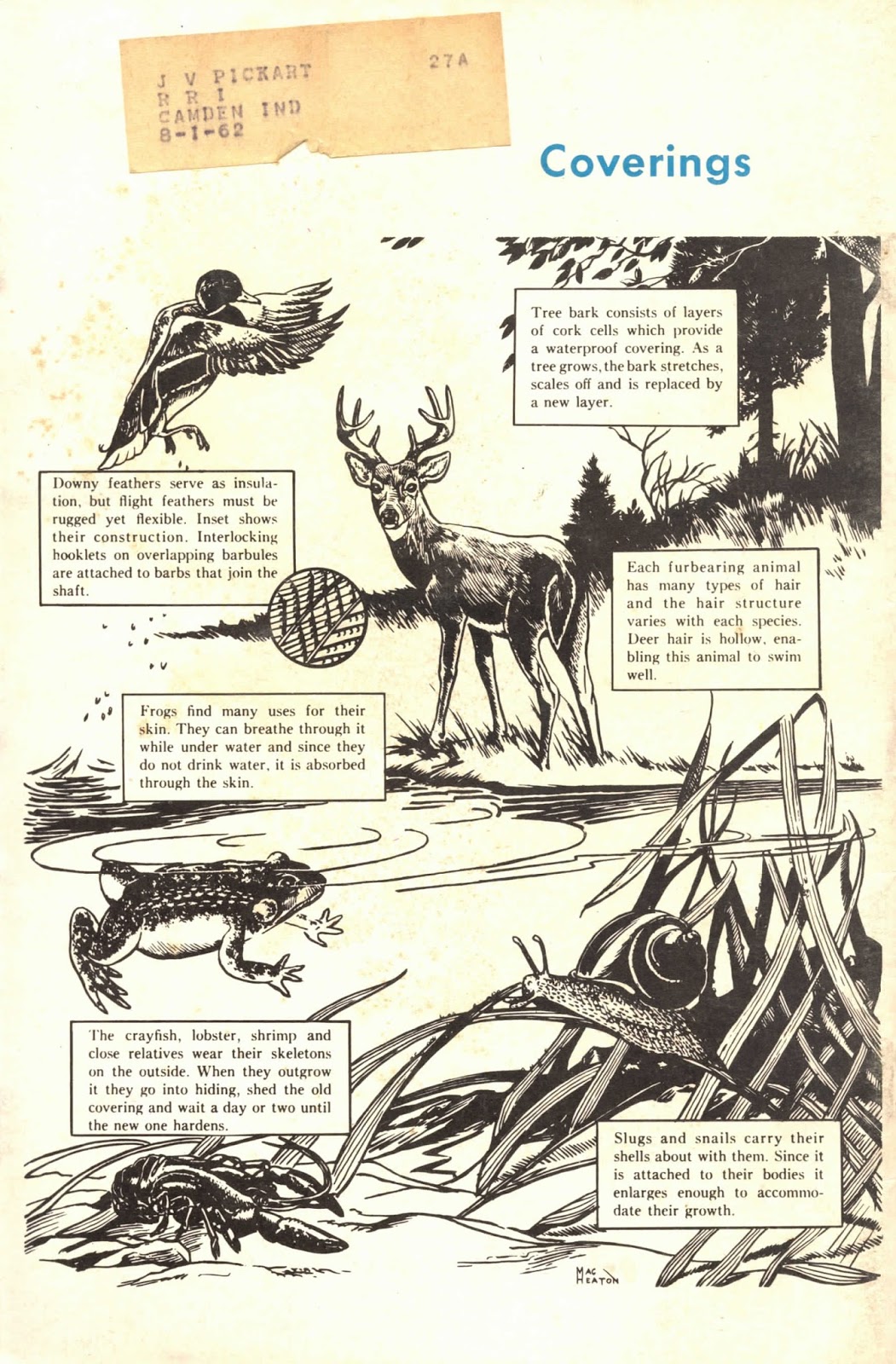
Finally, another back cover drawing, this one illustrating a biological concept, "Coverings," from Outdoor Indiana, July 1964. 

Note: My computer died last month, and though I have a new computer, I have been without a scanner for a while. Now I'm back in the blogging business, but I have fallen well behind in my writing. Please bear with me while I catch up.

Text copyright 2016, 2024 Terence E. Hanley

Friday, January 1, 2016

Indiana's Fifth First Lady

Today is the first day of Indiana's bicentennial year, so Happy Birth Year to the Hoosier State!

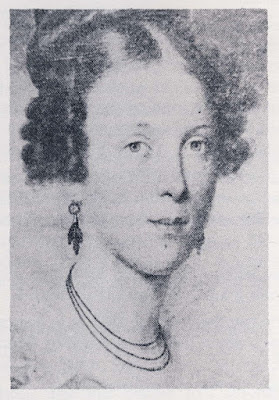
Awhile back, I wrote about Jonathan Jennings (1784-1834), first governor of Indiana. Unfortunately, there isn't any known likeness of his wife, Ann Gilmore Hay Jennings (1792-1825). In fact, there aren't any extant images of Indiana's first four first ladies, at least in the book First Ladies of Indiana and The Governors, 1816-1984 by Margaret Moore Post (1984). The first for whom we have a portrait is Catherine Stull Van Swearingen Noble, shown below. It's the only drawing or painting of a first lady in the book, thus the only work of an artist who was not also a photographer.

Catherine Stull Van Swearingen, called Kitty, was born on August 23, 1801, presumably at her father's plantation at Berryville, Virginia. Her parents were Eli Van Swearingen, a wealthy banker, and Ann (Noble) Van Swearingen. On November 8, 1819, at age eighteen, Kitty married her cousin, Noah Noble (1794-1844), in a Virginia church. Despite the difference in their ages, they had played together as children. Kitty then considered Noah to be "on the bossy side and told him so." (1) After marrying, the two traveled together by horseback to Brookville, Indiana, where Noble had previously been in business. With them were part of Kitty's dowry, what Margaret Moore Post perhaps euphemistically called "black servants." Jonathan Jennings and the first Indiana constitutional convention had ensured that Indiana would be a staunchly free state. The disposition of Kitty's "servants" is unknown, although her husband later provided for former slaves from his father's estate. More on that below.

Noah Noble was made a colonel in the state militia in 1820, the same year in which he was elected sheriff of Franklin County, of which Brookville is the seat of government. In 1823, he was collector of county and state revenue, in 1824 county lister (or assessor). That same year, 1824, Noble was elected to the Indiana House of Representatives. In 1826, he became receiver of public monies in the Indianapolis land office and relocated to the young capital city where he lived the rest of his life.

In the 1820s and perhaps into the 1830s, Noble assembled a large tract of land just east of Indianapolis in what is now the neighborhood of Holy Cross Catholic Church. The boundaries of what was then the Noble farm are College Avenue (then called Noble Avenue) on the west, Arsenal Avenue on the east, St. Clair Avenue on the north, and Washington Street on the south. (2) That figures to about 300 acres in all, an area now occupied by houses and businesses and by about fifteen acres of the grounds of Arsenal Technical High School. There may not be any traces in the area of the Noble family or their presence except for a couple of place names and, if the stories are accurate, an old oak tree, said to have been planted by Kitty Noble in what is now Highland Park. (3)

The Noble house, called Liberty Hall, was a large and very fine house located on Market Street near Pine Street. The ceilings were twelve feet high. Eight fireplaces warmed the bottom floor. A dozen Gordon setters roamed its halls. On the grounds were a vineyard, a peach orchard, an apple orchard, and a sugar grove. The governor and his wife were renowned for their hospitality.
Their entertaining was famous all over the country [wrote the Indianapolis Star in 1964] and invitations to the Noble soirees were greatly sought after. While Kitty was First Lady she entertained at long tables set with rare imported china and silver brought with her as a bride from Virginia. She wore a set of five matching coral cameos presented to "my beloved Kitty" by the Governor with her gowns of damask and velvet. (4)
Kitty Noble bore four children, of which only two, Catherine Mary Noble (1822-1851) and Winston Park Noble (1834-1899), survived to adulthood. "Kitty Noble is said to have spent much time training her daughter and son in duties and manners," wrote Margaret Moore Post, "and the children dressed for dinner each evening." (p. 25) A friend remembered Kitty as "always having a spirit of adventure tempered by a desire for a serious home life and deep rooted Christian faith." (5)

In 1831, Noah Noble's sister, Lavenia Noble Vance (1804-1885), sent former slaves from their father's estate into Noble's care. They were the Magruder family, old Tom, his wife Sarah, and then or later their children, Moses and Louisa. (6) Noble built a cabin for them on his farm in Indianapolis, at the northeast corner of what is now College Avenue and Market Street. A roundabout story leads from Tom Magruder and his cabin to one of the most important novels in American history.

From 1839 to 1847, Henry Ward Beecher (1813-1887) was a minister of the Second Presbyterian Church in Indianapolis. He lived at New Jersey and Market streets, only three blocks west of the Magruder cabin. Beecher was a frequent visitor there and at Liberty Hall. He officiated at the wedding of Catherine Mary Noble to Alexander H. Davidson in 1840. He also spoke at the memorial service of Noah Noble at his death in 1844. In his sermons, he was said to have mentioned Tom Magruder and his deep faith.

Beecher's sister, the writer Harriet Beecher Stowe (1811-1896), visited with her brother during his sojourn in Indianapolis. She is supposed to have met Tom and his family, as well. A strong case can be made that she based the characters from her book Uncle Tom's Cabin (1852), at least in part, on them. A decade after the book, a bestseller, was published, its author met President Abraham Lincoln, who is supposed to have said to her, "So you're the little woman who wrote the book that made this great war!" The story is considered apocryphal. If it were true in any way, we might say that the origins of the Civil War were in Indianapolis, in the area of what is now a nondescript gray brick-and-block building and its parking lot at College and Market. There isn't even a historical plaque to mark the spot where Tom Magruder's cabin once stood.

Noah Noble, a Whig, was elected Indiana's fifth governor in 1831 and served until the end of his second term in 1837. Noble continued in public service after leaving office. His name became associated with disastrous public debt and he returned to private life in 1841. Noah Noble died on February 8, 1844. His wife survived him by thirty years and passed away at age seventy-three on July 12, 1874. Both lie now in Crown Hill Cemetery in Indianapolis. Some of their household furnishings were sent to the Wylie House in Bloomington, Indiana. Noble County, Indiana, is named in his honor.

As for the artist who painted the portrait of Catherine Stull Van Swearingen Noble above, his or her identity is unknown. The image is a scan from Margaret Moore Post's book from 1984. It was probably copied from a photograph that appeared in the Indianapolis Star twenty years before. The caption of that photograph says that the portrait was painted in 1820 and was supposed to have been "an excellent likeness." It does not identify the artist. If the portrait was painted in 1820, it seems unlikely that it was done in Indiana. In a quick search of Pioneer Painters of Indiana by Wilbur D. Peat (1954), I didn't come up with a candidate, as the state was yet so young as to have had few portraitists of sufficient skill. Cincinnati, Kentucky, or even Virginia seem more likely places for its execution. The caption doesn't give the location of the painting, either. It may now be in the collections of Indiana University. I hope that it hasn't been lost, and I hope that someday soon we'll know the name of the artist.

Notes
(1) From "Indiana's Fifth First Lady Grew Up on Virginia Plantation" by Mary Waldon, Indianapolis Star, April 19, 1964, p. 102.
(2) Another source says that the northern boundary of the farm was the present-day New York Street. That would make the Noble property significantly smaller than 300 acres.
(3) St. Clair Avenue was probably named for the St. Clair family, who were connected to the Noble family by the marriage of Lavenia Noble, daughter of Dr. Thomas Noble (1762-1817) and Elizabeth Claire Sedgwick Noble (1764-1830 or 1837) and sister of Noah Noble, to Arthur St. Clair Vance (1801-1849), grandson of Major General Arthur St. Clair II (1737-1818) of Revolutionary War fame. It's worth noting that a character in Uncle Tom's Cabin is named Augustine St. Clare. Some names in the book match up with real-life people connected to the Noble and Magruder families.
Highland Avenue and Highland Park were apparently named for Highland Home, the residence of the Nobles' daughter, Catherine Mary Noble Davidson, and her husband, Alexander H. Davidson. The house was built after the death of Noah Noble. Highland Park, at New York Street and Highland Avenue, now occupies the site of the house, which was torn down in 1898 or shortly thereafter. Alternatively, the home was named after a place already called Highland, situated as it is at an elevation of about 750 feet above sea level and offering a view of the city to the west, which is as much as 45 to 50 feet lower in elevation.
(4) From Waldon in the Indianapolis Star.
(5) Ditto.
(6) The case of Tom Magruder is somewhat confused in that, according to a page on the website of the Indiana Historical Society, a Thomas Megruder, who had a son named Moses, was a slave kept by a James Noble of Dearborn County, Indiana. According to that page, Megruder "remained in the county until Noble's widow died. At that time, Noah Noble, who later became an Indiana governor, gave Megruder his freedom. One of Megruder's sons, Moses, was among those who founded the AME church on Lake Street in Lawrenceburg during the early 1850s." Another document, authored by Allan M. Stranz of the Federal Writers' Project and dated December 29, 1937 (click for a link), would seem to clear up the confusion:
James Noble (1785-1831) was the older brother of Noah Noble, a resident of Lawrenceburg in Dearborn County, a member of the first state constitutional convention, the first U.S. Senator from Indiana, and a prosecutor in the Fall Creek Massacre case. James Noble died in Washington, D.C., in 1831, the same year in which Lavenia Noble Vance sent Tom Magruder and his family to Indianapolis. (The death date of James Noble's wife, Mary Lindsay Noble, is unknown. There seems to be confusion in this case between her and James Noble's mother, Elizabeth Claire Sedgwick Noble, or between James Noble and one of those two women.) The Noble family may have continued to hold the Magruder family as slaves in Kentucky up to that time. According to Allan M. Stranz, "When the widow of Thomas Noble died in 1837 [sic], the [Noble] children agreed among themselves to set the old couple free." The date 1837 may not be correct for the death of Elizabeth Claire Sedgwick Noble. If it was instead 1830, as other sources indicate, then the date for the relocation of Tom and Sarah Magruder to Indianapolis in 1831 fits. Still, it indicates that the Noble family, residents of Indiana, still held slaves as late as 1831. The Magruders were by law the property of Thomas and Elizabeth Noble's daughters: in Dr. Noble's will, the real property had gone to his sons, the personal property, including slaves, to his daughters. Nevertheless, James and Noah Noble, both Whigs and both officeholders in Indiana, a free state, were uncomfortably close to an institution they supposedly abhorred. Today that would make for a scandal of gigantic proportions. 
For more on Thomas Megruder, see the website of the Indiana Historical Society, here. For more on Senator James Noble, see: "James Noble" by Nina K. Reid in The Indiana Quarterly Magazine of HistoryVol. 9, No. 1 (Mar. 1913), pp. 1-13, here.

Noah Noble, a portrait by Jacob Cox from before 1840. Born in 1810 in Philadelphia, Cox arrived in Indianapolis in 1833 and opened a portrait studio in 1835. In all, he painted six portraits of Indiana governors. Cox died in 1892.

I had hoped to find an illustration of Uncle Tom's Cabin done by an Indiana artist--but no luck. Instead, I'll show the cover of Uncle Tom's Cabin for Children, adapted by Helen Ring Robinson (1878-1923), designed by W. M. Rhoads (note the cutout on the cover), and illustrated by at least two artists, one named H.S. Adams, another named Allender. The book was published in Philadelphia by The Penn Publishing Company in 1908.

According to an article in an Indianapolis newspaper of the 1850s, a daguerrotype of the original Magruder cabin was taken before the cabin was "removed." Any daguerrotype has failed to turn up, and the exact meaning of the word removed is unknown--was it torn down, or could someone taking the long view have attempted to save it for posterity? (Source: "Indianapolis Then and Now: Louisa Magruder’s House, 564 N. Highland Avenue" by Joan Hostetler at the website Historic Indianapolis.com, November 21, 2013, accessible by clicking here.)

Text copyright 2015, 2024 Terence E. Hanley

Friday, December 11, 2015

Indiana Pioneers-Transportation

Today the Hoosier State of Indiana enters its two-hundreth year, for on December 11, 1816, it was admitted to the Union as the nineteenth state. Of the forty-eight contiguous states, Indiana is the smallest located west of the Appalachians. Nonetheless, it has made outsized contributions to the nation's culture and history, being first, most, and only in many categories, including agriculture, military service, manufacturing, automobiles, aviation, space exploration, education, literature, and art.

Ours is a state of pioneers. Whether in a flatboat, covered wagon, airplane, or spacecraft, Hoosiers have led the way. In observance of Indiana's pioneering efforts in transportation, I offer a number of illustrations by an artist who was herself descended from Indiana pioneers, Clotilde Embree Funk (1893-1991) of Princeton.

Postscript: The New York Times has cited my biographical article on Clotilde Embree Funk. The Times' article is called "Draw, She Said," and the author is David W. Dunlap. Mr. Dunlap's article is dated December 9, 2015, and it includes a photograph of Clotilde. In her hand is what Rooster Cogburn would have called "a big horse pistol." Believe it or not, when the picture was taken in 1926, Clotilde was target shooting in the basement of the Times Tower.


Happy Bison-tennial, Indiana!

Text copyright 2015, 2024 Terence E. Hanley

Tuesday, June 30, 2015

James Forbes (1797-1881)

Jonathan Jennings (1784-1834)
First governor of Indiana, painted by Scottish-American portraitist James Forbes (1797-1881).

The president of the first Indiana constitutional convention and the first governor of the State of Indiana was Jonathan Jennings (1784-1834), a man described as "gentle and kind" and one "of polished manners." (1) Jennings, staunch in his opposition to slavery, served two terms as governor and nine terms in the U.S. House of Representatives. Despite all that, he died in poverty, and his body laid in an unmarked grave for fifty-seven years after his death. Jennings County, Indiana, the only Jennings County in America, is named in his honor. It is the birthplace of Jessamyn West (1902-1984) and her cousin, Hannah Milhous Nixon (1885-1967), mother of the president. Jessamyn West's book and the movie made from it, The Friendly Persuasion, are set in the county of her birth.

The official portrait of Jonathan Jennings was painted by James Forbes. In all, Forbes painted six official portraits of Indiana's governors, yet little is--or was--known of him or his career. That has changed a little in this Internet age. The website AskArt lists four artists named James Forbes. Three of those four may very well have been the same man discussed by art historian Wilbur D. Peat in Pioneer Painters of Indiana (1954) and Portraits and Painters of the Governors of Indiana, 1800-1978 (revised edition, 1978). Archivists and genealogists Sandy Stamm and Lynda Hawley of Plainwell, Michigan, have done as much as anyone in uncovering information about James Forbes. I would like to acknowledge and thank them for their work.

James Forbes (Wilbur Peat called him James G. Forbes) was born on October 1, 1797, in Peterhead, Aberdeenshire, Scotland, to William Forbes and Mary (Walker) Forbes. James Forbes painted in Aberdeen and also taught painting there. John Phillip (1817-1867) was one of his students. "During the 1850s," wrote Wilbur Peat, "[Forbes] exhibited his work at the Royal Scottish Academy, Edinburgh, and at the Royal Academy and the British Institute, London." (2) He immigrated to the United States in 1859 and by September of that year was in Chicago, where he "conducted an oil painting studio at Washington and Dearborn streets. He had some beautiful specimens of art in his collection." (3) In 1860, Forbes had a studio at 88 LaSalle Street. Wilbur Peat suggested that Forbes was gone from Chicago by 1868, but Lynda Hawley has found information that his studio and many of his paintings were destroyed in the Great Chicago Fire of 1871.

No one knows how James Forbes came to Indiana. Wilbur Peat speculated that Forbes' acquaintance with H.F. Blount of Evansville "induced him to seek commissions here." (4) According to Peat, Forbes spent several winters in Evansville, a city in the the far southern part of the state and one known for its comparatively mild winters. Evansville may very well have offered a haven to an artist from cold and windy Chicago.

Forbes painted a portrait of Evansville mayor John B. Baker in 1868 or 1869. "Through this commission," related Peat, "Forbes was introduced to Governor Conrad Baker, brother of the mayor, a meeting that resulted in his being asked to paint a number of the governors of Indiana for the Statehouse collection at Indianapolis." (5) The idea of commissioning and collecting portraits of the state's governors was conceived by Governor Baker, who asked that the legislature set aside $200 apiece for the canvases. Thus about ten portraits were completed in 1869-1870, including the six painted by James Forbes in his temporary quarters in Evansville and in Indianapolis. In addition to the portrait of Jonathan Jennings, Forbes created likenesses of governors Ratliff Boon, James Whitcomb, Paris Chipman Dunning, Oliver Perry Morton, and Conrad Baker himself. The first three are copies from other sources, the last three from life.

As for James Forbes' personal life, on May 15, 1824, he married Mary Waters (1797-1853) in Peterhead, Aberdeenshire, Scotland. The couple had eight children, two boys and six girls. Two of the girls died in infancy. Forbes' oldest daughter, Mary Forbes Forbes (she married her cousin William Forbes) was a dressmaker and also a portraitist. Jane Forbes Gamack taught music, while the youngest Forbes girl, Elizabeth or Lizzie Forbes Forbes (she married her cousin John), taught art. Both Mary and Lizzie taught in Kalamazoo, Michigan.

According to archivist Sandy Stamm, the Forbeses and other Scottish families settled in the area of Plainwell, in Allegan County, Michigan, north of Kalamazoo. As evidence, a community called New Aberdeen still exists northwest of Plainwell. Ms. Stamm's associate, Lynda Hawley, writes that James Forbes bought a farm from his brother John Forbes. I assume it to have been in the Plainwell area. In the Federal census of 1880, Forbes was living with his daughter Mary and her husband (his nephew) William Forbes in the village of Plainwell. James Forbes died the following year, on March 25, 1881, in Plainwell. He was eighty-three years old. In the coming bicentennial of the first Indiana constitutional convention, I would like to remember the president of that convention, Jonathan Jennings, and the artist who painted his official portrait, James Forbes.

Notes
(1) Quoted in Portraits and Painters of the Governors of Indiana, 1800-1978 by Wilbur Peat, Diane Gail Lazarus, and Lana Ruegamer (Indiana Historical Society and Indianapolis Museum of Art, 1978), p. 16.
(2) Pioneer Painters of Indiana by Wilbur D. Peat (Indianapolis: Art Association of Indianapolis, 1954), p. 49.
(3) History of Cook County, Illinois, Vol. 1 (1909), p. 587.
(4) Pioneer Painters, p. 49.
(5) Ditto, p. 50.

Thanks to Sandy Stamm, Lynda Hawley, and Ransom District Library, Plainwell, Michigan, for further information on James Forbes.
Text copyright 2015, 2024 Terence E. Hanley

Monday, June 29, 2015

Corydon Capitol by Mac Heaton

We're now six months away from the beginning of Indiana's bicentennial year. Although Indiana did not become a state until December 11, 1816, the celebrations and observances have already begun and will only accelerate when 2016 arrives.

From June 10 to June 29, 1816, forty-three delegates met in Corydon, Indiana, to draw up a constitution for what would become the nation's nineteenth state. The Harrison County courthouse--the building that would become the new state's first capitol building--had not yet been completed. Tradition holds that the delegates held their sessions under a large, spreading elm tree instead. That tree succumbed to Dutch elm disease in 1925, but the trunk of the Constitution Elm remains protected by a sandstone monument in Corydon.

The Corydon capitol building has fared better and is now an Indiana State Museum Historic Site. In 1970, the Indiana Department of Natural Resources issued a booklet called The Corydon Capitol State Memorial. The cover artist was Malcolm "Mac" Heaton (1925-2002), staff artist for and art director of the DNR, earlier the Department of Conservation. His design appears in the image above.

There are many bicentennial dates to come. The bicentennial of the first Indiana constitutional convention is among the first of real significance. So Happy 199th Birthday to Indiana's first constitution!

Caption copyright 2015, 2024 Terence E. Hanley

Thursday, August 28, 2014

Indiana Bison-tennial!

We're still a year and a half away from the beginning of Indiana's bicentennial year, but I would like to be among the first to make the connection between that celebration and the Indiana State Seal, which includes the image of an American bison, and to say:

Happy Bison-tennial, Indiana!

The Seal of the State of Indiana, a design proposed before Indiana was a state. Only two other states--Kansas and North Dakota--include the image of a bison on their state seals. Both were admitted to the Union after Indiana. That will make the Hoosier State the first to observe a bison-tennial. By the way, whoever designed the seal is a candidate for the first illustrator to call Indiana home.

Update (Mar. 30, 2015): As it turns out, I was not the first to make the connection between the state seal and the bicentennial, but my wishes are the same. Also, there are some who believe that William Henry Harrison created the seal, modified from the original seal of the old Northwest Territory.

Text and caption copyright 2014, 2024 Terence E. Hanley

Friday, July 1, 2011

Postage Stamps

In commemoration of the American Revolution and the birth of our great country, I offer postage stamps by or based on the work of Indiana illustrators and Hoosier cartoonists. You'll find Revolutionary War heroes, presidents, a yellow kid, a rickety trolley car, and many other images here. Happy Birthday, America!

"Herkimer at Oriskany 1777 by Yohn," a 13-cent commemorative issued for the bicentennial of the American Revolution. The illustration from the stamp is from a painting by Indiana illustrator Frederick Coffay Yohn (1875-1933).
And a reproduction of the original, painted in about 1901. As a young artistic prodigy, Yohn painted pictures of historical scenes from the American and English Revolutions. His work was favorably compared to Howard Pyle's. According to Wikipedia, Yohn's original painting is at the Utica Public Library in Utica, New York.
George Rogers Clark at Vincennes, located in what is now Indiana, accepting the surrender of the British garrison in 1779. The event was a turning point of the war in the west, captured by Frederick C. Yohn in a painting for Youth's Companion in 1923 and adapted to a commemorative stamp in 1929, the sesquicentennial year of the surrender.
"Presidents of the United States," a sheet of commemoratives designed by Indiana illustrator Gene Jarvis (1921-1990) and Michael Halbert and issued by the Marshall Islands in 2005. 
A stamp design by Paul A. Wehr (1914-1973) for the sesquicentennial of Indiana statehood, 1966. In keeping with the patriotic theme, I can tell you that Wehr was born in Mount Vernon, Indiana. In another five years, Indiana will celebrate its bicentennial, and what a celebration it will be.
"American Illustrators," a sheet of stamps commemorating some of our greatest illustrators and issued in 2000. Although none of the stamps represents the work of a Hoosier, the decoration at the top is by Franklin Booth (1874-1948), an Indiana farmboy made good in the art world of New York.
"Comic Strip Classics" from 1995, the centennial year (or the year before the centennial year, depending on whom you ask) for newspaper comic strips in America (hence in the world--sorry, European theorists). I don't think the artwork is original, but I have never heard any comment on that possibility. In any case, Hoosier cartoonists represented on the sheet are three in number: First, Fontaine Fox (1884-1964), creator of Toonerville Folks. Although he was born in Louisville, Kentucky, Fox went to school at Indiana University and that's where a large collection of his art resides. Second, Harold Gray (1894-1968) and his Little Orphan Annie. Gray was born in Kankakee, Illinois, but grew up in Indiana and graduated from Purdue University with a degree in engineering. The title of his comic strip is from a poem by James Whitcomb Riley of Greenfield, Indiana. Third, Dale Messick (1906-2005), creator of Brenda Starr Reporter and native of South Bend. Dale was one of the first female cartoonists to find success in syndication. Her work is also on deposit at Indiana University. Other strips with an Indiana connection: The Yellow Kid, aka Hogan's Alley, drawn by George Luks after the creator of the strip, R.F. Outcault, had left--to draw another version of the strip. Assisting Luks on Hogan's Alley was Paul Plaschke (1880-1954), a German-born artist who lived in southern Indiana for many years. And another alley, Gasoline Alley, created by Frank King and carried on after King's death by Dick Moores (1909-1986), in his day one of the most widely admired of cartoonists.
The more recent "Sunday Funnies," with a column of stamps showing Garfield and Odie, creations of Jim Davis of Fairmount, Indiana.
Finally, detail from "The Art of Disney-Imagination" from  2008.  What's the Indiana connection? Bill Peet (1915-2002) of Grandview adapted the story for 101 Dalmatians from Dodie Smith's novel and helped develop the characters. Victor Haboush (1924-2009), who attended the Herron School of Art in Indianapolis, was among the animators. Peet and fellow Hoosier Harry Reeves contributed to the story in Cinderella as well. And who else but Phil Harris (1904-1995) of Linton, Indiana, could provide the voice for Mowgli's beloved friend Baloo in The Jungle Book? 
Postscript: "Pioneers of American Industrial Design," a sheet of "Forever" stamps issued by the U.S. Postal Service this year, 2011. Among the designers commemorated is Walter Dorwin Teague (1883-1960), a native of Pendleton, Indiana, who, before making his mark as an industrial designer, worked as an illustrator. That's his design for a camera, middle, far left.

Captions copyright 2011, 2024 Terence E. Hanley