If you count by fives, this is an anniversary year for wars and wartime events. The First World War, then called the Great War, now also called World War I, commenced one hundred years ago, on July 28, 1914. After an armistice and peace treaty in 1918-1919 and a twenty-year respite, war resumed on September 1, 1939, seventy-five years ago this year. Seventy years ago next week, on June 6, 1944, Allied forces cracked Hitler's "Fortress Europe" by landing at Normandy. And fifty years ago this summer, on August 7, 1964, Congress passed the Gulf of Tonkin Resolution, which authorized President Lyndon Johnson to go to war against North Vietnam.
There were happier events in 1964. The Beatles arrived in the United States for the first time on February 7 and performed on The Ed Sullivan Show on February 9. The arrival of John, Paul, George, and Ringo on American shores was no wartime event, but it signaled a British Invasion. The Ford Mustang made its debut that year. So did Jonny Quest, on September 18. Early in 1964, at about the time The Beatles were taking America by storm, a new kind of toy was displayed at a New York City toy fair. By Christmastime, that toy was available in stores and sold well at $4 a pop. The toy was a doll, but it was never called a doll for fear boys would reject it. Instead, G.I. Joe was an "action figure" and the toy every boy wanted during the 1960s and '70s. Since then, Hasbro's G.I. Joe has made his way into comic books, animated cartoons, movies, and video games.
American soldiers were called G.I.s as early as World War I, though doughboy is the term more popularly associated with the men of that war. The term G.I. Joe is from the World War II years and came from the imagination of cartoonist Pvt. Dave Breger. (1) Born in Chicago on April 15, 1908, Breger graduated from Northwestern University with a degree in abnormal psychology and without any formal training--other than that degree--in cartooning. Breger started selling cartoons in the 1930s. He was drafted in 1941, but he didn't let life in the U.S. Army keep him from drawing. The Saturday Evening Post printed his cartoon series Private Breger beginning on August 30, 1941. The Army noticed the young artist's talents and transferred him to its Special Services Division in New York in early 1942. On June 17, 1942, Breger's G.I. Joe made its debut in the first issue of Yank, The Army Weekly. By then of course, America was at war. In addition to millions of men under arms and women in uniform, the U.S. military sent writers, correspondents, combat artists, and cartoonists overseas. Among them--probably the most famous among them--was Ernie Pyle. Even Ernest Hemingway, who called himself "Ernie Hemorrhoid, the poor man's Pyle," paled in comparison.
Ernie Pyle was born on August 3, 1900, near Dana, Indiana. He served in the U.S. Navy during World War I and studied at Indiana University. Pyle made a name for himself as a journalist and columnist during the 1930s. When war came, he went to Europe as a war correspondent, arriving first in Belfast, Ireland, where he covered a unit of the Iowa National Guard, part of the 34th Infantry Division. A company in that unit became Pyle's favorite and the basis, in part, for a movie called The Story of G.I. Joe.
From Northern Ireland, Ernie Pyle went on to London, then North Africa, Sicily, Italy, and France. (2) His dispatches from the front won him fame in Europe and back home. His book, Here Is Your War, about the campaign in North Africa, was published in 1943. For his reporting, Pyle was awarded a Pulitzer Prize in 1944. Other books followed towards the end and after the war. In January 1945, Pyle arrived in the Pacific Theater. Three months later, on the island of Ie Shima, he was killed by Japanese machine gun fire.
Late in 1943, Lester Cowan, an independent movie producer, began work on the film that would become The Story of G.I. Joe. The war's events raced ahead of the moviemakers; the Allies were well on their way to victory by the time filming began in late 1944. The storyline of the movie was drawn from Here Is Your War and Brave Men (1944). Burgess Meredith played Ernie Pyle. Robert Mitchum and a number of lesser-known actors and even a couple of boxers rounded out the cast. The Story of G.I. Joe was released on June 18, 1945, two months to the day after Ernie Pyle's death and after the German surrender. The movie was well received and was nominated for four Academy Awards, but came away empty handed.
In April 1950, Ziff-Davis began publishing a comic book called G.I. Joe. Set in Occupied Japan and Korea, G.I. Joe featured painted covers, some by famed pulp artist Norman Saunders. The title character is a big, brawling blond, happily going about his business of punching, kicking, gun-butting, and knocking the heads of his communist adversaries. He even wears a flower in his helmet strap. G.I. Joe lasted for fifty-one issues and came to a close in June 1957. Halfway through its run, G.I. Joe was subjected to the Mad treatment by cartoonist Wally Wood. Called "G.I. Schmoe," the sendup ran in Mad #10 (April 1954). If you have read it, you will remember the recurring punchline, "Hey, Joe! You got chewing gum?" (3) After G.I. Joe the action figure came out in 1964, DC published two issues of Showcase called G.I. Joe (#53, December 1964 and #54, February 1965). I don't know whether those were tie-ins to the release of the toy or not. After that, every comic book with the words G.I. Joe in the title was somehow or other related to Hasbro's coveted action figure.
We can be pretty sure that the comic book G.I. Joe had nothing to do with Dave Breger's original humorous version from the 1940s--as one source on the Internet claims--except for in the origin of its name. Instead, the comic book may have been inspired by the movie The Story of G.I. Joe. (4) If that's the case, and if G.I. Joe the action figure was named with the popularity of the comic book in mind, then it's likely that the lineage of "America's Movable Fighting Man" can be traced to Indiana's own Ernie Pyle. There's no telling if he would have approved, although he was always on the side of the dog-faced American soldier.
Notes
(1) The first record of the term in the New York Times, however, was in reference to Ernie Pyle's book, Here Is Your War. The Times published a book review entitled "Ernie Pyle's Story of G.I. Joe," written by Edward Streeter, on October 31, 1943 (p. BR1). The Chicago Tribune used the term for the first time on May 19, 1943.
(2) Dick Wingert (1919-1993), a native Iowan and a soldier in the 34th Infantry Division, took the same path from Northern Ireland to London, though in a different capacity. Like Dave Breger, Wingert was stationed in Louisiana before the war. He arrived with his unit in Northern Ireland in early 1942. Also like Breger, Wingert was untrained as a cartoonist, yet gained fame for his comic panel Hubert, which was printed in Stars and Stripes.
(3) In 1945, a German firm, Schon-Druck, issued a set of sixteen postcards entitled "G.I. Joe in Bavaria." The artist was named Trautloft. The situations are comic. One card shows a Bavarian boy with a large stein of beer, apparently offered for trade to G.I. Joe with the question: "You have Kaugummi?" Kaugummi is the German word for chewing gum.
(4) I haven't seen the movie, but the clincher might be if there is a G.I. who wears a flower in his helmet strap, like the comic book version of the 1950s.
(2) Dick Wingert (1919-1993), a native Iowan and a soldier in the 34th Infantry Division, took the same path from Northern Ireland to London, though in a different capacity. Like Dave Breger, Wingert was stationed in Louisiana before the war. He arrived with his unit in Northern Ireland in early 1942. Also like Breger, Wingert was untrained as a cartoonist, yet gained fame for his comic panel Hubert, which was printed in Stars and Stripes.
(3) In 1945, a German firm, Schon-Druck, issued a set of sixteen postcards entitled "G.I. Joe in Bavaria." The artist was named Trautloft. The situations are comic. One card shows a Bavarian boy with a large stein of beer, apparently offered for trade to G.I. Joe with the question: "You have Kaugummi?" Kaugummi is the German word for chewing gum.
(4) I haven't seen the movie, but the clincher might be if there is a G.I. who wears a flower in his helmet strap, like the comic book version of the 1950s.
 |
| The original G.I. Joe, created by Dave Breger (1908-1970) in 1942 and published in book form in 1945. Breger also drew Private Breger, which became, after the war, Mister Breger. Those two comic panels ran in syndication from 1942 to 1970. I wonder now if Antonio Prohias (1921-1998), creator of Spy vs. Spy for Mad magazine, was influenced by Breger. |
 |
| A poster or lobby card for The Story of G.I. Joe, a film released through United Artists in 1945, after Ernie Pyle's death. The image is of Pyle himself and not of Burgess Meredith (1907-1997), who played him in the movie. |
 |
| A magazine advertisement for the same film. Note that the image of Pyle has been reversed. Also note the Bill Mauldin-like cartoons along the bottom. Ernie Pyle knew Bill Mauldin (1921-2003) and wrote of him for the people back home. Like Pyle, Mauldin was a Pulitzer Prize winner for his coverage of the war. |
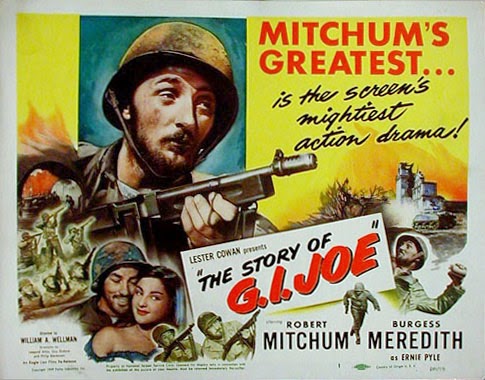 |
| A more dramatic and Hollywood-ized poster or lobby card for The Story of G.I. Joe. |
 |
| Finally, another poster, advertisement, or lobby card. This image may have predated the others, but I have saved it for last because of the dog. . . |
 |
| Which reappeared on the cover of the G.I. Joe comic book in the 1950s. I don't know whether the comic book was inspired by the movie, but the dog might be a clue. |
 |
| G.I. Joe wasn't always happy-go-lucky. Here he rescues a nurse. |
 |
| In 1954, G.I. Joe got the Mad treatment at the hands of Wally Wood. That's good evidence that G.I. Joe was not an obscurity. That may, in turn, be evidence of the connection between the earlier movie and the later action figure. Note the flower in Galusha Iggy Schmoe's helmet strap. |
 |
| G.I. Joe in Showcase #53, which showed up in time for Christmas, 1964, at about the same time as the new G.I. Joe action figure. The cover artist was Joe Kubert. |
 |
| At last, the G.I. Joe we all know in an advertisement from the 1960s. G.I. Joe was inducted into the National Toy Hall of Fame in 2004. That makes this year another anniversary year. |
 |
| Update (Jan. 12, 2015): If you follow a straight line long enough, it makes a circle. In 2002, Hasbro released an Ernie Pyle G.I. Joe action figure, complete with typewriter and newspaper. The release was timed to coincide with the anniversary of the landing at Normandy. |
Happy Memorial Day week to all my readers, especially those who have fought to keep our country free. Or, as Ernie Pyle wrote: "Thanks, pal."
Text and captions copyright 2014, 2024 Terence E. Hanley


