Thursday, January 7, 2016

The International Day of the Cartoonist 2016

One year ago today, on January 7, 2015, five cartoonists were murdered in Paris in the offices of the satirical newspaper Charlie Hebdo. They were Wolinski, Cabu, Honoré, Tignous, and Charb--respectively, George David Wolinski (1934-2015), Jean Cabut (1938-2015), Philippe Honoré (1941-2015), Bernard Verlhac (1957-2015), and Stéphane Charbonnier (1967-2015). Their murderers were Islamists, and we must never forget that, but they were also part of a larger force that has always been with us. That force is the drive that makes people want to control the lives of other people--a force that will never die but which must always be resisted.

Last year on this date, I proposed that January 7 be named and forever observed as the International Day of the Cartoonist. Right now, I'm the only one to observe it I think. I hope that others will join in, but even if they don't, I'll continue observing it and continue remembering those who have died or who have been imprisoned, tortured, arrested, oppressed, or denied their rights simply for their art.

Recently, the death of another cartoonist was confirmed. Syrian cartoonist Akram Raslan was arrested by the Syrian regime on October 2, 2012, at the offices of the newspaper Al-Fida in Hama, Syria. Raslan was held, apparently incommunicado, in a Syrian jail. He may have been tortured. His death was confirmed late last year as having taken place in the spring of 2013.

Born in Souran, Syria, in 1978, Akram Raslan drew more than 300 cartoons in support of the revolt against the rule of Bashir al-Assad. In 2013, in absentia, he was given the Award for Courage in Editorial Cartooning by the Cartoonists Rights Network International (CRNI). Indiana cartoonist Joel Pett said at the time: "CRNI gives Akram Raslan our annual Award for Courage in Editorial Cartooning in recognition of his extraordinary courage in confronting the forces of violence with cartoons that told only the truth." By the time of the award ceremony, which took place on June 29, 2013, Akram Raslan had very likely died as a result of his being jailed.

You can read more about Akram Raslan and other cartoonists at the website of the Cartoonists Rights Network International at the following URL:


* * *

Indiana has long given its men and women into service to their country. They of course have included artists, illustrators, and cartoonists. Most returned to civilian life. I know of only one to have died on active duty. His name was Asa Henderson King, and he was born on May 12, 1880, in Boone County, Indiana. His parents were William H. King (1833-1928) and Susannah Jane (Mendenhall) King (1844-1882). Asa was the youngest of their four children and was only two years old when his mother died.

In 1897, Asa Henderson King moved to Clinton County. I know only that he was an artist and cartoonist. On May 4, 1915, three days before the Lusitania was torpedoed by a German submarine, he enlisted in the U.S. Army in New York City. From there he was sent to Fort Jay, New York, for training, then assigned to Company F of the 29th Infantry Regiment. That same year, the 29th Infantry was dispatched to Panama to guard the Panama Canal. The unit returned to the United States in September 1918. Evidently King remained in Panama, for that was where he died, at Camp Gailliard, on June 6, 1919. The cause was heart trouble. Private Asa Henderson King was buried at Corozal American Cemetery in Corozal, Panama. His name is inscribed on the Clinton County War Memorial in Frankfort, Indiana.

Hoosier cartoonist Asa Henderson King (1880-1919). The photograph is from the website Find A Grave.

Text copyright 2015, 2024 Terence E. Hanley

Friday, January 1, 2016

Indiana's Fifth First Lady

Today is the first day of Indiana's bicentennial year, so Happy Birth Year to the Hoosier State!

Awhile back, I wrote about Jonathan Jennings (1784-1834), first governor of Indiana. Unfortunately, there isn't any known likeness of his wife, Ann Gilmore Hay Jennings (1792-1825). In fact, there aren't any extant images of Indiana's first four first ladies, at least in the book First Ladies of Indiana and The Governors, 1816-1984 by Margaret Moore Post (1984). The first for whom we have a portrait is Catherine Stull Van Swearingen Noble, shown below. It's the only drawing or painting of a first lady in the book, thus the only work of an artist who was not also a photographer.
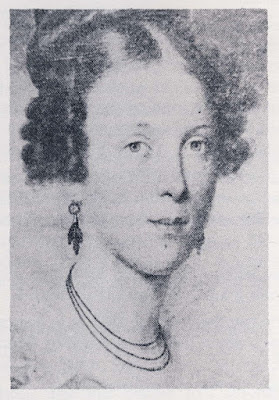

Catherine Stull Van Swearingen, called Kitty, was born on August 23, 1801, presumably at her father's plantation at Berryville, Virginia. Her parents were Eli Van Swearingen, a wealthy banker, and Ann (Noble) Van Swearingen. On November 8, 1819, at age eighteen, Kitty married her cousin, Noah Noble (1794-1844), in a Virginia church. Despite the difference in their ages, they had played together as children. Kitty then considered Noah to be "on the bossy side and told him so." (1) After marrying, the two traveled together by horseback to Brookville, Indiana, where Noble had previously been in business. With them were part of Kitty's dowry, what Margaret Moore Post perhaps euphemistically called "black servants." Jonathan Jennings and the first Indiana constitutional convention had ensured that Indiana would be a staunchly free state. The disposition of Kitty's "servants" is unknown, although her husband later provided for former slaves from his father's estate. More on that below.

Noah Noble was made a colonel in the state militia in 1820, the same year in which he was elected sheriff of Franklin County, of which Brookville is the seat of government. In 1823, he was collector of county and state revenue, in 1824 county lister (or assessor). That same year, 1824, Noble was elected to the Indiana House of Representatives. In 1826, he became receiver of public monies in the Indianapolis land office and relocated to the young capital city where he lived the rest of his life.

In the 1820s and perhaps into the 1830s, Noble assembled a large tract of land just east of Indianapolis in what is now the neighborhood of Holy Cross Catholic Church. The boundaries of what was then the Noble farm are College Avenue (then called Noble Avenue) on the west, Arsenal Avenue on the east, St. Clair Avenue on the north, and Washington Street on the south. (2) That figures to about 300 acres in all, an area now occupied by houses and businesses and by about fifteen acres of the grounds of Arsenal Technical High School. There may not be any traces in the area of the Noble family or their presence except for a couple of place names and, if the stories are accurate, an old oak tree, said to have been planted by Kitty Noble in what is now Highland Park. (3)

The Noble house, called Liberty Hall, was a large and very fine house located on Market Street near Pine Street. The ceilings were twelve feet high. Eight fireplaces warmed the bottom floor. A dozen Gordon setters roamed its halls. On the grounds were a vineyard, a peach orchard, an apple orchard, and a sugar grove. The governor and his wife were renowned for their hospitality.
Their entertaining was famous all over the country [wrote the Indianapolis Star in 1964] and invitations to the Noble soirees were greatly sought after. While Kitty was First Lady she entertained at long tables set with rare imported china and silver brought with her as a bride from Virginia. She wore a set of five matching coral cameos presented to "my beloved Kitty" by the Governor with her gowns of damask and velvet. (4)
Kitty Noble bore four children, of which only two, Catherine Mary Noble (1822-1851) and Winston Park Noble (1834-1899), survived to adulthood. "Kitty Noble is said to have spent much time training her daughter and son in duties and manners," wrote Margaret Moore Post, "and the children dressed for dinner each evening." (p. 25) A friend remembered Kitty as "always having a spirit of adventure tempered by a desire for a serious home life and deep rooted Christian faith." (5)

In 1831, Noah Noble's sister, Lavenia Noble Vance (1804-1885), sent former slaves from their father's estate into Noble's care. They were the Magruder family, old Tom, his wife Sarah, and then or later their children, Moses and Louisa. (6) Noble built a cabin for them on his farm in Indianapolis, at the northeast corner of what is now College Avenue and Market Street. A roundabout story leads from Tom Magruder and his cabin to one of the most important novels in American history.

From 1839 to 1847, Henry Ward Beecher (1813-1887) was a minister of the Second Presbyterian Church in Indianapolis. He lived at New Jersey and Market streets, only three blocks west of the Magruder cabin. Beecher was a frequent visitor there and at Liberty Hall. He officiated at the wedding of Catherine Mary Noble to Alexander H. Davidson in 1840. He also spoke at the memorial service of Noah Noble at his death in 1844. In his sermons, he was said to have mentioned Tom Magruder and his deep faith.

Beecher's sister, the writer Harriet Beecher Stowe (1811-1896), visited with her brother during his sojourn in Indianapolis. She is supposed to have met Tom and his family, as well. A strong case can be made that she based the characters from her book Uncle Tom's Cabin (1852), at least in part, on them. A decade after the book, a bestseller, was published, its author met President Abraham Lincoln, who is supposed to have said to her, "So you're the little woman who wrote the book that made this great war!" The story is considered apocryphal. If it were true in any way, we might say that the origins of the Civil War were in Indianapolis, in the area of what is now a nondescript gray brick-and-block building and its parking lot at College and Market. There isn't even a historical plaque to mark the spot where Tom Magruder's cabin once stood.

Noah Noble, a Whig, was elected Indiana's fifth governor in 1831 and served until the end of his second term in 1837. Noble continued in public service after leaving office. His name became associated with disastrous public debt and he returned to private life in 1841. Noah Noble died on February 8, 1844. His wife survived him by thirty years and passed away at age seventy-three on July 12, 1874. Both lie now in Crown Hill Cemetery in Indianapolis. Some of their household furnishings were sent to the Wylie House in Bloomington, Indiana. Noble County, Indiana, is named in his honor.

As for the artist who painted the portrait of Catherine Stull Van Swearingen Noble above, his or her identity is unknown. The image is a scan from Margaret Moore Post's book from 1984. It was probably copied from a photograph that appeared in the Indianapolis Star twenty years before. The caption of that photograph says that the portrait was painted in 1820 and was supposed to have been "an excellent likeness." It does not identify the artist. If the portrait was painted in 1820, it seems unlikely that it was done in Indiana. In a quick search of Pioneer Painters of Indiana by Wilbur D. Peat (1954), I didn't come up with a candidate, as the state was yet so young as to have had few portraitists of sufficient skill. Cincinnati, Kentucky, or even Virginia seem more likely places for its execution. The caption doesn't give the location of the painting, either. It may now be in the collections of Indiana University. I hope that it hasn't been lost, and I hope that someday soon we'll know the name of the artist.

Notes
(1) From "Indiana's Fifth First Lady Grew Up on Virginia Plantation" by Mary Waldon, Indianapolis Star, April 19, 1964, p. 102.
(2) Another source says that the northern boundary of the farm was the present-day New York Street. That would make the Noble property significantly smaller than 300 acres.
(3) St. Clair Avenue was probably named for the St. Clair family, who were connected to the Noble family by the marriage of Lavenia Noble, daughter of Dr. Thomas Noble (1762-1817) and Elizabeth Claire Sedgwick Noble (1764-1830 or 1837) and sister of Noah Noble, to Arthur St. Clair Vance (1801-1849), grandson of Major General Arthur St. Clair II (1737-1818) of Revolutionary War fame. It's worth noting that a character in Uncle Tom's Cabin is named Augustine St. Clare. Some names in the book match up with real-life people connected to the Noble and Magruder families.
Highland Avenue and Highland Park were apparently named for Highland Home, the residence of the Nobles' daughter, Catherine Mary Noble Davidson, and her husband, Alexander H. Davidson. The house was built after the death of Noah Noble. Highland Park, at New York Street and Highland Avenue, now occupies the site of the house, which was torn down in 1898 or shortly thereafter. Alternatively, the home was named after a place already called Highland, situated as it is at an elevation of about 750 feet above sea level and offering a view of the city to the west, which is as much as 45 to 50 feet lower in elevation.
(4) From Waldon in the Indianapolis Star.
(5) Ditto.
(6) The case of Tom Magruder is somewhat confused in that, according to a page on the website of the Indiana Historical Society, a Thomas Megruder, who had a son named Moses, was a slave kept by a James Noble of Dearborn County, Indiana. According to that page, Megruder "remained in the county until Noble's widow died. At that time, Noah Noble, who later became an Indiana governor, gave Megruder his freedom. One of Megruder's sons, Moses, was among those who founded the AME church on Lake Street in Lawrenceburg during the early 1850s." Another document, authored by Allan M. Stranz of the Federal Writers' Project and dated December 29, 1937 (click for a link), would seem to clear up the confusion:
James Noble (1785-1831) was the older brother of Noah Noble, a resident of Lawrenceburg in Dearborn County, a member of the first state constitutional convention, the first U.S. Senator from Indiana, and a prosecutor in the Fall Creek Massacre case. James Noble died in Washington, D.C., in 1831, the same year in which Lavenia Noble Vance sent Tom Magruder and his family to Indianapolis. (The death date of James Noble's wife, Mary Lindsay Noble, is unknown. There seems to be confusion in this case between her and James Noble's mother, Elizabeth Claire Sedgwick Noble, or between James Noble and one of those two women.) The Noble family may have continued to hold the Magruder family as slaves in Kentucky up to that time. According to Allan M. Stranz, "When the widow of Thomas Noble died in 1837 [sic], the [Noble] children agreed among themselves to set the old couple free." The date 1837 may not be correct for the death of Elizabeth Claire Sedgwick Noble. If it was instead 1830, as other sources indicate, then the date for the relocation of Tom and Sarah Magruder to Indianapolis in 1831 fits. Still, it indicates that the Noble family, residents of Indiana, still held slaves as late as 1831. The Magruders were by law the property of Thomas and Elizabeth Noble's daughters: in Dr. Noble's will, the real property had gone to his sons, the personal property, including slaves, to his daughters. Nevertheless, James and Noah Noble, both Whigs and both officeholders in Indiana, a free state, were uncomfortably close to an institution they supposedly abhorred. Today that would make for a scandal of gigantic proportions. 
For more on Thomas Megruder, see the website of the Indiana Historical Society, here. For more on Senator James Noble, see: "James Noble" by Nina K. Reid in The Indiana Quarterly Magazine of HistoryVol. 9, No. 1 (Mar. 1913), pp. 1-13, here.

Noah Noble, a portrait by Jacob Cox from before 1840. Born in 1810 in Philadelphia, Cox arrived in Indianapolis in 1833 and opened a portrait studio in 1835. In all, he painted six portraits of Indiana governors. Cox died in 1892.

I had hoped to find an illustration of Uncle Tom's Cabin done by an Indiana artist--but no luck. Instead, I'll show the cover of Uncle Tom's Cabin for Children, adapted by Helen Ring Robinson (1878-1923), designed by W. M. Rhoads (note the cutout on the cover), and illustrated by at least two artists, one named H.S. Adams, another named Allender. The book was published in Philadelphia by The Penn Publishing Company in 1908.

According to an article in an Indianapolis newspaper of the 1850s, a daguerrotype of the original Magruder cabin was taken before the cabin was "removed." Any daguerrotype has failed to turn up, and the exact meaning of the word removed is unknown--was it torn down, or could someone taking the long view have attempted to save it for posterity? (Source: "Indianapolis Then and Now: Louisa Magruder’s House, 564 N. Highland Avenue" by Joan Hostetler at the website Historic Indianapolis.com, November 21, 2013, accessible by clicking here.)

Text copyright 2015, 2024 Terence E. Hanley

Monday, December 28, 2015

Eugene Mumaw (1930-2006)

Fred Eugene Mumaw was an artist almost unknown in his time and in ours. That was and is an unfortunate state of affairs, for he was a talented man with a unique style. Born on April 3, 1930, Mumaw loved cartoons and cartooning, evidently from an early age as so many cartoonists do. He graduated from Muncie Central High School in 1948 and worked in quality control for Ball Corporation for forty-seven years. Mumaw also created posters for the Muncie Civic Theatre for a quarter of a century. You can view them at the Ball State University Libraries Digital Media Repository by clicking here. A member of St. Lawrence Catholic Church in Muncie, Mumaw died on September 12, 2006, in Muncie and was buried at Elm Ridge Memorial Park in the city of his birth.

Time was when kids who wrote to well-known cartoonists would receive in return a piece of original art. Here is an example from Eugene Mumaw's collection, a daily comic panel of Toonerville Folks, inscribed to him "with the compliments of Fontaine Fox."

Mumaw's cartoony illustrations are marked by simplicity, humor, and a sure touch. This and all the illustrations below were done, I believe, with gouache or opaque watercolor. Update: A comment below indicates that Eugene Mumaw used cut paper in creating his art. I can't say whether all of these illustrations are done with cut paper or with some other media.


Mumaw's art has been selling on the Internet for some time. His undated pinup-type drawings are especially popular.

These might fall generally into the category of "good girl art," one that was popular in the 1940s and '50s among comic book artists and magazine illustrators.

The renowned "Vargas Girl" from Esquire magazine is an example of good girl art. Eugene Mumaw's pin-ups may have been his take on the Vargas-type girl.

To me, they are far more innocent.

And I think you an tell that the artist was having great fun drawing them.

Here's to remembering a nearly forgotten Indiana illustrator, Eugene Mumaw of Muncie.

Revised and undated January 12, 2020.
Text copyright 2015, 2024 Terence E. Hanley

Saturday, December 19, 2015

Max Altekruse (1921-2015)

Max Lavern Altekruse was born on August 16, 1920, in Fort Wayne, Indiana, to William P. and Ola B. (Wyrick) Altekruse. His father was an electrician and his mother a housewife. As a child Altekruse enjoyed copying Norman Rockwell's cover illustrations for the Saturday Evening Post. Decades later he returned to Rockwell-like scenes in his work for makers of collector plates.

At North Side High School in Fort Wayne, Max Altekruse, nicknamed "Blondy," was a member of the Camera Club and won a scholarship in art. After graduating high school in 1938, he attended the Fort Wayne Art School, where he studied under Homer Davisson (1866-1957) and Forrest F. Stark (1903-1977).  He then got a job as a commercial artist at the Bonsib Advertising Agency under Louis William Bonsib (1892-1979).

In the summer of 1942, Altekruse married Mary Jane "Kathy" Long and enlisted in the United States Army. Returning stateside after three years in the South Pacific, he attended the Pennsylvania Academy of the Fine Arts at his wife's urging. He went on to study at the Art Students League in New York City under Frank J. Reilly (1906-1967).

Altekruse spent fifty years as a commercial illustrator. His clients included Eli Lilly, Ford, Chrysler, Goodyear, the Franklin Mint, the Collectors Studio, and others. For many years he worked at McNamara and Associates, a Detroit advertising agency. He also taught illustration and composition at the Center for Creative Studies in Detroit. 

After retiring in 1995, Altekruse returned to painting. His awards over the years included first prize at the Scarab Club Annual Watercolor Show (Detroit, 1962 and 1963), the Annual Merit Award from the Society of Illustrators (1980), and inclusion in the National Parks Academy of the Arts Annual, Top 100 Paintings (1998) and Top 200 paintings (2004). 

A resident of Franklin, Michigan, Altekruse was president of the Franklin Historical Society. During his tenure, Franklin became the first city in Michigan to be listed in the National Register of Historic Places.

Max Altekruse died on February 21, 2015.

The Broughton House, a drawing in pencil by Max Altekruse from circa 1980.


Two illustrations by Altekruse from the August 1983 issue of Ford Times.

Max Altekruse served in the U.S. military during World War II. Forty years later, in 1995, he provided this illustration for the cover of the book Weapon Systems.

Altekruse was also known for his illustrations for collector plates. This one is called "Walking in the Rain" and is from the Wonders of Childhood Plate Collection from The Collectors Studio.

Max Altekruse appears to be an undiscovered artist. Considering his fifty-year career, I think there is a lot of his art out in the world, yet little of it seems to have found its way into books or onto the Internet. I would like to correct that oversight. If anyone has art or images by Altekruse, I would like to see them and post them here.

Updated August 9, 2020.
Text and captions copyright 2015, 2024 Terence E. Hanley

Friday, December 11, 2015

Indiana Pioneers-Transportation

Today the Hoosier State of Indiana enters its two-hundreth year, for on December 11, 1816, it was admitted to the Union as the nineteenth state. Of the forty-eight contiguous states, Indiana is the smallest located west of the Appalachians. Nonetheless, it has made outsized contributions to the nation's culture and history, being first, most, and only in many categories, including agriculture, military service, manufacturing, automobiles, aviation, space exploration, education, literature, and art.

Ours is a state of pioneers. Whether in a flatboat, covered wagon, airplane, or spacecraft, Hoosiers have led the way. In observance of Indiana's pioneering efforts in transportation, I offer a number of illustrations by an artist who was herself descended from Indiana pioneers, Clotilde Embree Funk (1893-1991) of Princeton.

Postscript: The New York Times has cited my biographical article on Clotilde Embree Funk. The Times' article is called "Draw, She Said," and the author is David W. Dunlap. Mr. Dunlap's article is dated December 9, 2015, and it includes a photograph of Clotilde. In her hand is what Rooster Cogburn would have called "a big horse pistol." Believe it or not, when the picture was taken in 1926, Clotilde was target shooting in the basement of the Times Tower.


Happy Bison-tennial, Indiana!

Text copyright 2015, 2024 Terence E. Hanley

Wednesday, November 25, 2015

The Revolutionary War

This year, 2015, is a year of anniversaries by tens: the 200th anniversary of the end of the War of 1812, the 150th anniversary of the end of the Civil War, and the 70th anniversary of the end of World War II. It is also the 240th anniversary of the beginning of the Revolutionary War. That beginning took place on April 19, 1775, at Lexington and Concord when British forces engaged and were forced into retreat by the Minutemen of Massachusetts. The war carried on for eight more years, with the last British troops leaving New York City on today's date--November 25--in 1783. In 1776, we declared our independence. In 1777, we won the battles that turned the tide. And in 1778-1781, we secured our freedom by defeating the British in the West and in the South, with a culminating victory at Yorktown on October 19, 1781. Artists, writers, historians, thinkers, and the American people at large have celebrated those events ever since. Illustrators and cartoonists from Indiana are of course among them.

Lucy Fitch Perkins (1865-1937) of Maples, Indiana, was renowned for her Twins series of books. Here is the cover of The American Twins of the Revolution, published in 1926, presumably to celebrate the sesquicentennial of Independence. The Revolutionary War is unique in our history. Fought on our own soil and in every part of our young nation, it touched and influenced the lives of every American as no war has in the time since. Those lives included the lives of children. I would hazard that there have been more children's books about children participating in the Revolutionary War than about any other American war. Johnny Tremain by Esther Forbes (1943) leaps to mind.

Roy Frederic Heinrich (1881-1943) was born in Goshen, Indiana, but lived much of his life in the East. Late in his career, he executed a series of historical drawings for the National Life Insurance Company of Montpelier, Vermont. Here is his depiction of the Battle of Hubbardton, July 7, 1777, in what is now Vermont. The British and their Hessian mercenaries won the battle but at great cost.

Frederick Coffay Yohn (1875-1933) of Indianapolis was a wunderkind artist, recognized by age twenty-five as one of the nation's top historical illustrators. He specialized in paintings of the American Revolution, many of which were published in Scribner's. Shown here is a scene from the Battle of Oriskany, August 6, 1777, in which the American General Nicholas Herkimer was mortally wounded in a loss to Loyalists or Tories and their Indian allies.

Yohn's painting was used as a design for a postage stamp in observance of the American Bicentennial.

Ten days after Oriskany, on August 16, 1777, American forces won a decisive victory at the Battle of Bennington. F.C. Yohn was the artist.

The caption here tells the story. The drawing is by Roy F. Heinrich. Again, the war was one in which all Americans might have taken part, including a housemaid wearing a dress as striped as her flag.

On October 17, 1777, British General John Burgoyne surrendered his forces to General Horatio Gates, thus bringing an end to the Saratoga campaign and helping to assure foreign recognition of the American cause. The artist was once again Yohn.

"The Interrupted Christmas Dinner--A Revolutionary Incident" by T. Dart Walker (1868-1914) of Goshen, Indiana. This image was published by Leslie's in 1900 and illustrates a story with which I am unfamiliar. The fineness and bravery of American women (and children) is evident here, as the American man in uniform hides under the table. 

Despite its victories, the Continental Army under George Washington suffered through a hard winter in 1777-1778 at Valley Forge. F.C. Yohn painted this monochromatic picture.

In 1777, the British opened a new theater in the war, the war in the West. From September 7 to September 18, 1778, Shawnee warriors, allied with the British, laid siege to Fort Boonesborough in what is now Kentucky. (The date on the picture frame is 1777.) The siege failed and only two died on the American side, including a slave named London. Daniel Boone and his brother Squire were at the siege. Squire Boone now lies buried in a cave in southern Indiana. The picture here was painted by Gayle Porter Hoskins (1887-1962) of Brazil, Indiana.

In February 1779, George Rogers Clark, with his small force of men, moved against Vincennes in what is now southwestern Indiana, crossing the flooded Wabash River bottoms from the Illinois country to the west. The children of Indiana learn of Clark's feat in fourth-grade history class and remember it forever after, if only for the story of men wading for miles through freezing floodwaters on their approach to the settlement. Frederick Coffay Yohn painted this picture in 1929. . . 

Only a few years after having painted this picture of the surrender of Fort Sackville at Vincennes, which took place on February 25, 1779. Henry Hamilton, the leader of the British forces, is on the right. George Rogers Clark, older brother of William Clark of Lewis and Clark fame, is on the left. Note the drummer boy on the far left and the girl in the blue dress on the far right. Indiana author Maurice Thompson's bestselling Alice of Old Vincennes (1900), illustrated by Yohn, is set against the backdrop of the Vincennes campaign.  

Yohn's painting was used as a design for a postage stamp commemorating the sesquicentennial of the surrender in 1929. 

For the British, the Southern theater of operations was far more active but only slightly more successful than the war in the West. Among the American heroes of the South was Francis Marion, the famed "Swamp Fox," who gave his name to Marion County, home of the capital city of Indiana. The drawing here is by Carl Kidwell (1910-2003) of Washington, Indiana. It adorns the dust jacket of The Swamp Fox by Marion Marsh Brown (1950). Note the unintentional double pun in the author's name.

In 1775, a newspaper comic strip called The Sons of Liberty went into syndication in anticipation of the American Bicentennial. The creator of the strip was Richard Jo Lynn (1937-2010) of Lagro, Indiana. Here is a piece of promotional art reprinted in Cartoonist Profiles magazine No. 36 (Dec. 1977). 

The Sons of Liberty culminated on the day of the Bicentennial, July 4, 1976, with a Sunday page, the only Sunday during the run of the strip. I believe this is the ending strip, but I can't say for sure, as the magazine article does not identify it as such. In any case, Happy Birthday to the Revolution that began in earnest 240 years ago!

Text and captions copyright 2015, 2024 Terence E. Hanley

Friday, November 20, 2015

Cartoonists and Power

On November 13, 2015, Islamic terrorists attacked several sites in and around Paris, in the process killing 130 people and injuring nearly 400 others. The Islamic State claimed responsibility. One of the attackers had only recently arrived in Europe in the flood of refugees fleeing the Syrian civil war.

The attack of November 13 was the second major attack to take place in Paris this year. On January 7, Islamists attacked the offices of the satirical newspaper Charlie Hebdo. The attackers killed eleven people and injured eleven others. Five of the dead--Jean Cabut, Stéphane CharbonnierPhilippe HonoréBernard Verlhac, and Georges Wolinski--were cartoonists. Wolinski was also Jewish. There were further terrorist actions in and around Paris over the next two days and countervailing shows of solidarity with the people of Paris in the following weeks. Our current president was conspicuously absent from the largest event, which took place on January 11 in Paris and included two million people and more than forty world leaders. 

On November 17 in Paris, Secretary of State John Kerry had the following to say about the two attacks:
There's something different about what happened [on November 13] from Charlie Hebdo, and I think everybody would feel that. There was a sort of particularized focus and perhaps even a legitimacy in terms of--not a legitimacy, but a rationale that you could attach yourself to somehow and say, okay, they're really angry because of this and that. This Friday was absolutely indiscriminate. It wasn't to aggrieve one particular sense of wrong. It was to terrorize people.
It isn't clear whether Kerry was speaking for himself, the President, the United States government, or anyone else, despite his claim that "everybody would feel that." He may not have been speaking in any formal capacity at all. His words sound informal and off the cuff. They are very nearly incoherent. Nonetheless, Secretary Kerry seems to have revealed his true thoughts, and his use of the word "legitimacy," despite any subsequent correction, places him in a category with Bill Donahue, president of the Catholic League; cartoonist Garry Trudeau of Doonesbury fame; and several members of PEN International, all of whom have suggested that the five murdered cartoonists of Charlie Hebdo provoked their own deaths or even that they deserved to die.

In response to the attacks of November 13, more than two dozen governors have stated that they will not accept Syrian refugees into their states, while at least five others have requested that any refugees be screened before entering. Among the governors not accepting refugees is Kentucky Governor-Elect Matt Bevin. On November 19, the Lexington Herald-Leader published an editorial cartoon by Hoosier cartoonist Joel Pett. The cartoon shows Bevin quaking with fear and hiding under his desk. On the floor is a map of Syria and a newspaper with the headline "Paris." On the governor-elect's desk are three pictures of his children. A fourth is being held by one of Bevin's aides, who is saying: "Sir, they're not terrorists . . . they're your own adopted kids!" I should point out that Matt Bevin is the father of ten children, four of whom are adopted from Ethiopia.

They say a picture is worth a thousand words. Indeed, today, the Lexington Herald-Leader chose to articulate with great clarity the deplorably racist ideology of "cartoonist" Joel Pett. Shame on Mr. Pett for his deplorable attack on my children and shame on the editorial controls that approved this overt racism.
Further:
Let me be crystal clear, the tone of racial intolerance being struck by the Herald-Leader has no place in the Commonwealth of Kentucky and will not be tolerated by our administration.
Pett, who lived in Africa for five years in his childhood, said that he is not a racist. He chalks up Bevin's reaction to "inexperience on his part."

Joel Pett's cartoon may or not be on target. It may or may not be in good taste. That's beside the point. The point is that a cartoonist here in the United States is facing threats, veiled as they may be, from someone far more powerful than he is, simply for expressing himself as an artist. In this country, that threat is ridiculous. Joel Pett is obviously not taking it seriously. In Paris, however, five cartoonists paid for their art with their lives. Contrary to what Garry Trudeau said, they were not operating from a position of power. They were not "punching down." They were in fact punching up against people far more powerful than they were. Their only weapon was a pen. Their killers used firearms and explosives.

What the Charlie Hebdo cartoonists drew may at times have been in poor taste, just as what Joel Pett and other political cartoonists draw may at times be. The issues, however, are simple: either artists have the right to express themselves or they do not. The threat or use of force against them is either legitimate or it is not. Where the Islamic terrorists stand on these issues is clear. Their position is not surprising. What is less clear is just where John Kerry, Garry Trudeau, and Matt Bevin stand. That's the part that is surprising, and I have to say, alarming.

Original text copyright 2015, 2024 Terence E. Hanley