Wednesday, August 10, 2016

Elizabeth Buchsbaum Newhall (1909-1942)-Part One

Teacher and illustrator Elizabeth Buchsbaum Newhall came from a distinguished family of scientists and artists. Sadly, her mother died when she was only an infant, and Elizabeth herself lived only a very short life. In creating the illustrations for a textbook still considered a standard in its field, Elizabeth Buchsbaum combined the two sides of her family, the scientific and the artistic. Although she was also a fine artist, her reputation now rests on her drawings of insects, worms, and other invertebrates.

Elizabeth Mabel Buchsbaum was born in 1909 in the Philippines. Her father, then a first lieutenant in the U.S. Army, was Dr. Maurice (Morris) Buchsbaum (1867-1935), a native of Austria who had arrived in the United States in 1890 and who had been naturalized on October 1, 1896. Dr. Buchsbaum received his bachelor's degree from the University of Chicago in 1903 and his medical degree from Rush Medical College of Chicago in 1905. He also taught internal medicine at that school. Dr. Buchsbaum joined the Medical Reserve Corps on September 25, 1908, in Oklahoma. After being stationed in Wyoming, Dr. Buchsbaum was transferred to Fort Mills on the Philippine island of Corregidor. He began at that post on October 30, 1909, as an assistant to the surgeon and was later stationed on the island of Mindanao and at the Presidio in San Francisco.

Elizabeth Buchsbaum's mother was Mabel Victor Buchsbaum about whom almost nothing is known, despite the fact that she lies buried in a national cemetery. Mabel Buchsbaum passed away on November 25, 1909, and was first laid to rest in the Philippines. Her body was reinterred at San Francisco National Cemetery, located at the Presidio, on April 1, 1910. Considering the circumstances of Elizabeth Buchsbaum Newhall's death in 1942 and the fact that her birth year is estimated in census records as 1910 rather than 1909, I think it possible that Mabel Buchsbaum died in childbirth. In any case, her daughter would have been only an infant at her death. Her son Ralph, born on January 2, 1907, in Chickasha, Oklahoma Territory, was not even three years old at her death.

Elizabeth Buchsbaum's widowed father was honorably discharged from the U.S Army on January 15, 1912. Less than a month later, on February 10, 1912, he married Hermine Josephine Beck in Chicago. Born in Bohemia in about 1877, she came to the United States in 1893. As of the 1910 U.S. Census, she was the superintendent of a hospital on Wrightwood Avenue in Chicago. In short order after the Buchsbaums' wedding, a second son, named Robert E. Buchsbaum, came into the family. He was born on December 25, 1912, in Chicago.

By 1918, the Buchsbaums were living in Gary, Indiana. Incorporated in 1906, Gary was then only a dozen years old and like the rest of the lake region of northwestern Indiana served as a bedroom community for people studying and working in Chicago. I presume that Elizabeth attended school in Gary, as her family had lived there from as early as 1918 and as late as the census of 1930, when she would have been twenty years old. According to the website American Illustration Notables, Circa 1900-1970, she studied at the Art Institute of Chicago. She also attended the University of Chicago. By 1935, Elizabeth was a teacher at Jefferson School in Gary. In 1939, she was at Edison School in the same city. Gary is no longer what it once was. Unfortunately, Jefferson and Edison schools have both fallen into neglect and decay.

Sometime around 1939-1941, Elizabeth M. Buchsbaum married Franklin Newhall (1914-2005), an agricultural climatologist specializing in soil moisture. Afterwards known as Elizabeth Buchsbaum Newhall, she died, supposedly in childbirth, on the night of December 30, 1942, in Chicago. Although her death was reported in The Jewish Post, her remains were interred at the First Unitarian Church crypt in Chicago. She was survived by her husband, stepmother, and her two brothers. Her husband went on to marry two more times and to live into his tenth decade on earth.

To be continued . . .

Dr. Maurice (Morris) Buchsbaum (1867-1935), father of teacher and illustrator Elizabeth Buchsbaum Newhall. The photograph is from his graduation from Rush Medical College in Chicago, 1905.

Jefferson School, Gary, Indiana, where Elizabeth taught during the 1930s.

Updated December 5, 2018.
Thanks to Sherry Buchsbaum for corrections and for further information on the Buchsbaum family. (See her comment below.)
Text copyright 2016, 2024 Terence E. Hanley

Wednesday, August 3, 2016

Mac Heaton Art Gallery

This year--this month in fact--is the centennial year of the establishment of the National Park Service (NPS), a milestone in the history of conservation in America. Two thousand sixteen is also the bicentennial year of the State of Indiana. Lost in those two big celebrations is the fact that 2016 is also the centennial year of the first state parks in Indiana, acquired through the tireless efforts of Richard Lieber (1869-1944). McCormick's Creek State Park, located in Owen County, was Indiana's first. Turkey Run State Park, located in Parke County and Colonel Lieber's favorite, came next. Both were dedicated on December 16, 1916, in conjunction with the centennial celebration of Indiana statehood. A little more than two years later, in March 1919, the governor signed a bill creating the Indiana Department of Conservation. Colonel Richard Lieber was named the first director. In 1965, the Indiana Department of Conservation was renamed the Indiana Department of Natural Resources (IDNR). The agency still bears that name.

The Department of Conservation began publishing a magazine called Outdoor Indiana in February 1934. In this age when magazines seem to be dying, Outdoor Indiana is still in print. In June 1945, artist Malcolm C. Heaton (1925-2002) went to work for Outdoor Indiana. In time he became art director of the Department of Conservation. Nicknamed Mac, Heaton was a versatile artist, as the illustrations below will show. He was adept at painting, drawing, and even cartooning. He worked at a time when state conservation agencies employed some outstanding wildlife artists, including Charles Schwartz (1914-1991) in Missouri, Bob Hines (1912-1994) in Ohio, and Ned Smith (1919-1985) in Pennsylvania. Mac Heaton stood among them as an artist from what might be called the golden age of conservation in America.

"Cornfield Covey" by Mac Heaton, a painting depicting a river-bottom field in Greene County, the artist's home county, for the November 1963 issue of Outdoor Indiana. Unfortunately, despite all the efforts of conservationists, a covey of bobwhite quail has become a rare sight in Indiana.

A drawing of a gull by Heaton, showing that he worked just as well in halftone as in full color. This illustration is from an article called "Gulls of Michigan City" by James Landing, from Outdoor Indiana, August 1963.

On March 22, 1824, seven white men murdered nine American Indians near Pendleton, Indiana, in an event now called the Fall Creek Massacre. The men were tried and some were executed for their crimes. It was the first time in American history that a white man was executed for a crime against an Indian. Outdoor Indiana had an article about the massacre in its August 1963 issue. The author was Arville L. Funk. Mac Heaton provided the illustration.

In addition to being an illustrator, Heaton was a cartoonist. Here is one of his cartoons, from the back cover of Outdoor Indiana, February 1964.

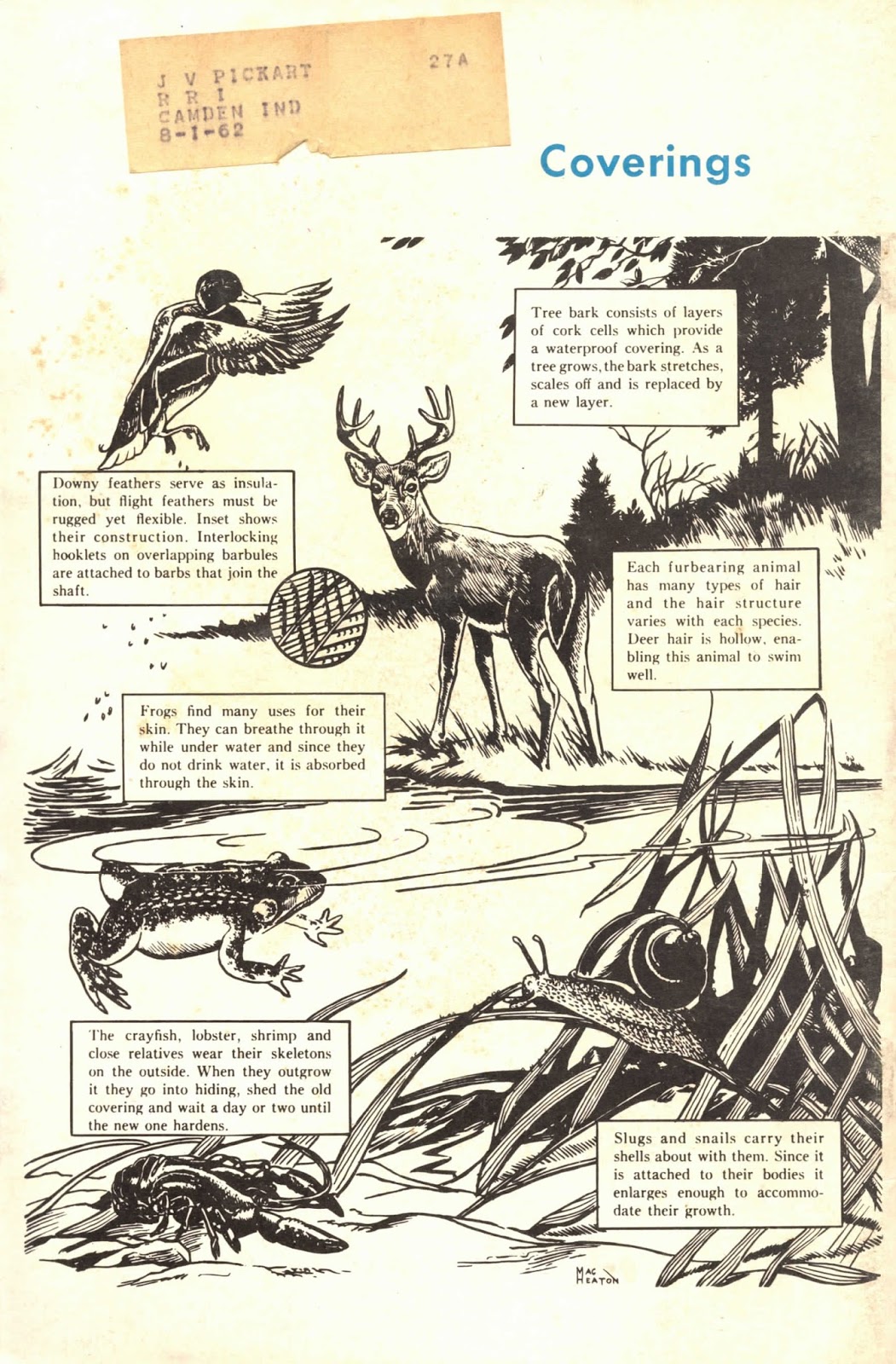
Finally, another back cover drawing, this one illustrating a biological concept, "Coverings," from Outdoor Indiana, July 1964. 

Note: My computer died last month, and though I have a new computer, I have been without a scanner for a while. Now I'm back in the blogging business, but I have fallen well behind in my writing. Please bear with me while I catch up.

Text copyright 2016, 2024 Terence E. Hanley

Friday, July 1, 2016

Joseph A. Trover (1915-2002)

Joseph Albert Trover was born on February 26, 1915, in a place called Four Corners in Vermillion County, Indiana. He studied with Simon Baus, George Jo Mess, C. Curry Bohm, and Edward R. Sitzman. Trover was a member of numerous art associations and won numerous prizes and honors. In addition to being a painter, he was an art teacher and a judge at art shows. You can read more about him at the following website:


Please be aware that some of the information on that website may not be entirely accurate.

Although he grew up in Dana, Indiana, and lived in Indianapolis, Joseph Trover was an artist of Brown County. I have not found any illustration or cartooning credits for him, but a few days ago I discovered at Half-Price Books a few copies of the magazine Outdoor Indiana from the 1960s. There on the cover of the October 1963 issue is the following image:


Bean Blossom is the name of a place in Brown County, a home to artists for more than a century. Trover owned an art gallery there. I have not seen this bridge that I remember, but in some places in Indiana, you don't have to drive far to come across a covered bridge. Parke County, adjacent to Trover's native county, is home to more covered bridges than any other county in America. Every fall, it has a covered bridge festival. By the way, Joseph A. Trover died in 2002.

I have been away for most of the last two months. That explains the lack of postings here. I hope to catch up in July and August with four postings per month. Next: more from Outdoor Indiana.

Text copyright 2016, 2024 Terence E. Hanley

Thursday, April 21, 2016

Charles Frederick Surendorf, Jr. (1906-1979)

Charles Frederick Surendorf, Jr., was born on November 9, 1906, in Richmond, Indiana. He attended the Art Institute of Chicago, the Art Students League, and Ohio State University. In 1929, he moved to Logansport, Indiana, and from there to California (in 1935), living first in Los Angeles, then in San Francisco. In 1946, he moved to Columbia, California, an old ghost town. Surendorf worked in all of those places as an artist, as well as in Tahiti, New Orleans, and the California desert.

In 1949, Charles Surendorf sent word home to his family in Logansport that he had married Barbara Stoner, a former model, beauty queen, and assistant curator of an art gallery in California. Like her new husband, Mrs. Surendorf was a Hoosier, having come from Goshen. The couple had three children together.

Charles Surendorf was a painter and a printmaker. In his younger days, he drew cartoons for his hometown newspaper. In the 1930s or early 1940s, he painted a mural of the Pottawatomie Indians in the Logansport library. Unfortunately that work was lost when the library burned in 1941. Surendorf won many prizes and accolades and had his work widely exhibited. He was also a member of many art associations and groups.

Surendorf was recognized in his time as one of the foremost woodblock/linoleum block printers in the United States. Charles F. Surendorf, Jr., died on May 28, 1979, in Columbia, California, at age seventy-two.

A self-portrait by Charles Frederick Surendorf, Jr., from 1935. This is an early example of his engraving. Others can be found all over the Internet with a simple search for his name. Good luck and happy viewing.

Text copyright 2016, 2024 Terence E. Hanley

Wednesday, April 20, 2016

James M. Triggs (1924-1992)

James Martin Triggs was born on March 2, 1924, in Indianapolis and was educated in Glen Ellyn, Illinois, and Mamaroneck, New York. He served in the U.S. military during World War II and studied at Cornell University and the Pratt Institute. Triggs got his start as a commercial artist working with Stevan Dohanos (1907-1994) and Coby Whitmore (1913-1988). Often working in a trompe l'oeil manner, he did advertising art and painted magazine covers for Argosy and other publications. He was especially interested in airplanes and firearms. Triggs was also an author, with the books The Piper Cub Story (1963) and Used Plane Buying Guide (1962) to his credit. James M. Triggs died on June 26, 1992, in Danbury, Connecticut.


Update (May 27, 2024): There is an article in the April 1985 issue of Southwest Art Magazine on James M. Triggs. It's called "Frontier Mementoes," and its author is Pamela Guthman.
Text copyright 2016, 2024 Terence E. Hanley

Sunday, March 20, 2016

Sister Esther Newport (1901-1986)

Catherine Newport was born on May 17, 1901, in Clinton, Indiana. In 1918, at age seventeen, she entered the Sisters of Providence of Saint Mary-of-the-Woods, an order residing west of Terre Haute, Indiana. Taking the name Sister Esther, she taught art in middle school and, beginning in 1930, at Saint Mary-of-the-Woods College. Sister Esther was at the Woods, as it is called colloquially, until 1964. After a two-year stint at Marywood School in Evanston, Illinois, she returned to Saint Mary-of-the-Woods to head the art department until 1970.

Sister Esther was educated at Saint Mary-of-the-Woods and at the School of the Art Institute of Chicago (bachelor of arts, 1932). She received a master of fine arts at Syracuse University in 1939 and an honorary doctorate from Saint Mary's College of Notre Dame, Indiana, in 1956. In addition to being a painter, illustrator, sculptor, and teacher, she was also a writer, lecturer, founder of the Catholic Art Association (in 1937), and editor (from 1937 to 1940) of Christian Social Art Quarterly (later Catholic Art Quarterly).

Sister Esther died at Saint Mary-of-the-Woods on July 9, 1986, at age eighty-five.

Today, March 20, 2016, is Palm Sunday, and a week before Easter. Indiana artist Sister Esther Newport drew this and the following pictures of the events leading to the death and resurrection of Jesus Christ for a book called A Bible History, with a History of the Church by Rev. Stephen J. McDonald and Elizabeth Jackson, published in 1940 by Row, Peterson and Company of Evanston, Illinois. I found this book just yesterday at a secondhand store.

The Last Supper

The Agony in the Garden

Jesus Before Caiphas

The Crucifixion

The Entombment of Jesus Christ

Jesus Appearing to Mary Magdalen

The Ascension into Heaven

Christus Rex

Text and captions copyright 2016, 2024 Terence E. Hanley
Friday, March 11, 2016

Leo James Beaulaurier (1911-1984)

Painter, illustrator, and muralist Leo James Beaulaurier was born on May 10, 1911, in Great Falls, Montana. We can call him a Hoosier for his three years of study at the University of Notre Dame in South Bend, Indiana. Beaulaurier also studied at the Art Center School in Los Angeles. He served in the U.S. Army during World War II and worked odd jobs and in construction until 1963, when he began painting full time. Beaulaurier specialized in scenes of the American West and is known for his portraits of American Indians on black velvet. Leo James Beaulaurier died in Great Falls, Montana, on February 11, 1984.

A portrait of Sitting Bull.
Boss Ribs by Beaulaurier.

Finally, a complete tableau of the Great American West.

Text copyright 2016, 2024 Terence E. Hanley