Friday, July 1, 2011

Postage Stamps

In commemoration of the American Revolution and the birth of our great country, I offer postage stamps by or based on the work of Indiana illustrators and Hoosier cartoonists. You'll find Revolutionary War heroes, presidents, a yellow kid, a rickety trolley car, and many other images here. Happy Birthday, America!

"Herkimer at Oriskany 1777 by Yohn," a 13-cent commemorative issued for the bicentennial of the American Revolution. The illustration from the stamp is from a painting by Indiana illustrator Frederick Coffay Yohn (1875-1933).
And a reproduction of the original, painted in about 1901. As a young artistic prodigy, Yohn painted pictures of historical scenes from the American and English Revolutions. His work was favorably compared to Howard Pyle's. According to Wikipedia, Yohn's original painting is at the Utica Public Library in Utica, New York.
George Rogers Clark at Vincennes, located in what is now Indiana, accepting the surrender of the British garrison in 1779. The event was a turning point of the war in the west, captured by Frederick C. Yohn in a painting for Youth's Companion in 1923 and adapted to a commemorative stamp in 1929, the sesquicentennial year of the surrender.
"Presidents of the United States," a sheet of commemoratives designed by Indiana illustrator Gene Jarvis (1921-1990) and Michael Halbert and issued by the Marshall Islands in 2005. 
A stamp design by Paul A. Wehr (1914-1973) for the sesquicentennial of Indiana statehood, 1966. In keeping with the patriotic theme, I can tell you that Wehr was born in Mount Vernon, Indiana. In another five years, Indiana will celebrate its bicentennial, and what a celebration it will be.
"American Illustrators," a sheet of stamps commemorating some of our greatest illustrators and issued in 2000. Although none of the stamps represents the work of a Hoosier, the decoration at the top is by Franklin Booth (1874-1948), an Indiana farmboy made good in the art world of New York.
"Comic Strip Classics" from 1995, the centennial year (or the year before the centennial year, depending on whom you ask) for newspaper comic strips in America (hence in the world--sorry, European theorists). I don't think the artwork is original, but I have never heard any comment on that possibility. In any case, Hoosier cartoonists represented on the sheet are three in number: First, Fontaine Fox (1884-1964), creator of Toonerville Folks. Although he was born in Louisville, Kentucky, Fox went to school at Indiana University and that's where a large collection of his art resides. Second, Harold Gray (1894-1968) and his Little Orphan Annie. Gray was born in Kankakee, Illinois, but grew up in Indiana and graduated from Purdue University with a degree in engineering. The title of his comic strip is from a poem by James Whitcomb Riley of Greenfield, Indiana. Third, Dale Messick (1906-2005), creator of Brenda Starr Reporter and native of South Bend. Dale was one of the first female cartoonists to find success in syndication. Her work is also on deposit at Indiana University. Other strips with an Indiana connection: The Yellow Kid, aka Hogan's Alley, drawn by George Luks after the creator of the strip, R.F. Outcault, had left--to draw another version of the strip. Assisting Luks on Hogan's Alley was Paul Plaschke (1880-1954), a German-born artist who lived in southern Indiana for many years. And another alley, Gasoline Alley, created by Frank King and carried on after King's death by Dick Moores (1909-1986), in his day one of the most widely admired of cartoonists.
The more recent "Sunday Funnies," with a column of stamps showing Garfield and Odie, creations of Jim Davis of Fairmount, Indiana.
Finally, detail from "The Art of Disney-Imagination" from  2008.  What's the Indiana connection? Bill Peet (1915-2002) of Grandview adapted the story for 101 Dalmatians from Dodie Smith's novel and helped develop the characters. Victor Haboush (1924-2009), who attended the Herron School of Art in Indianapolis, was among the animators. Peet and fellow Hoosier Harry Reeves contributed to the story in Cinderella as well. And who else but Phil Harris (1904-1995) of Linton, Indiana, could provide the voice for Mowgli's beloved friend Baloo in The Jungle Book? 
Postscript: "Pioneers of American Industrial Design," a sheet of "Forever" stamps issued by the U.S. Postal Service this year, 2011. Among the designers commemorated is Walter Dorwin Teague (1883-1960), a native of Pendleton, Indiana, who, before making his mark as an industrial designer, worked as an illustrator. That's his design for a camera, middle, far left.

Captions copyright 2011, 2024 Terence E. Hanley

Tuesday, June 21, 2011

Franklin Booth (1874-1948)

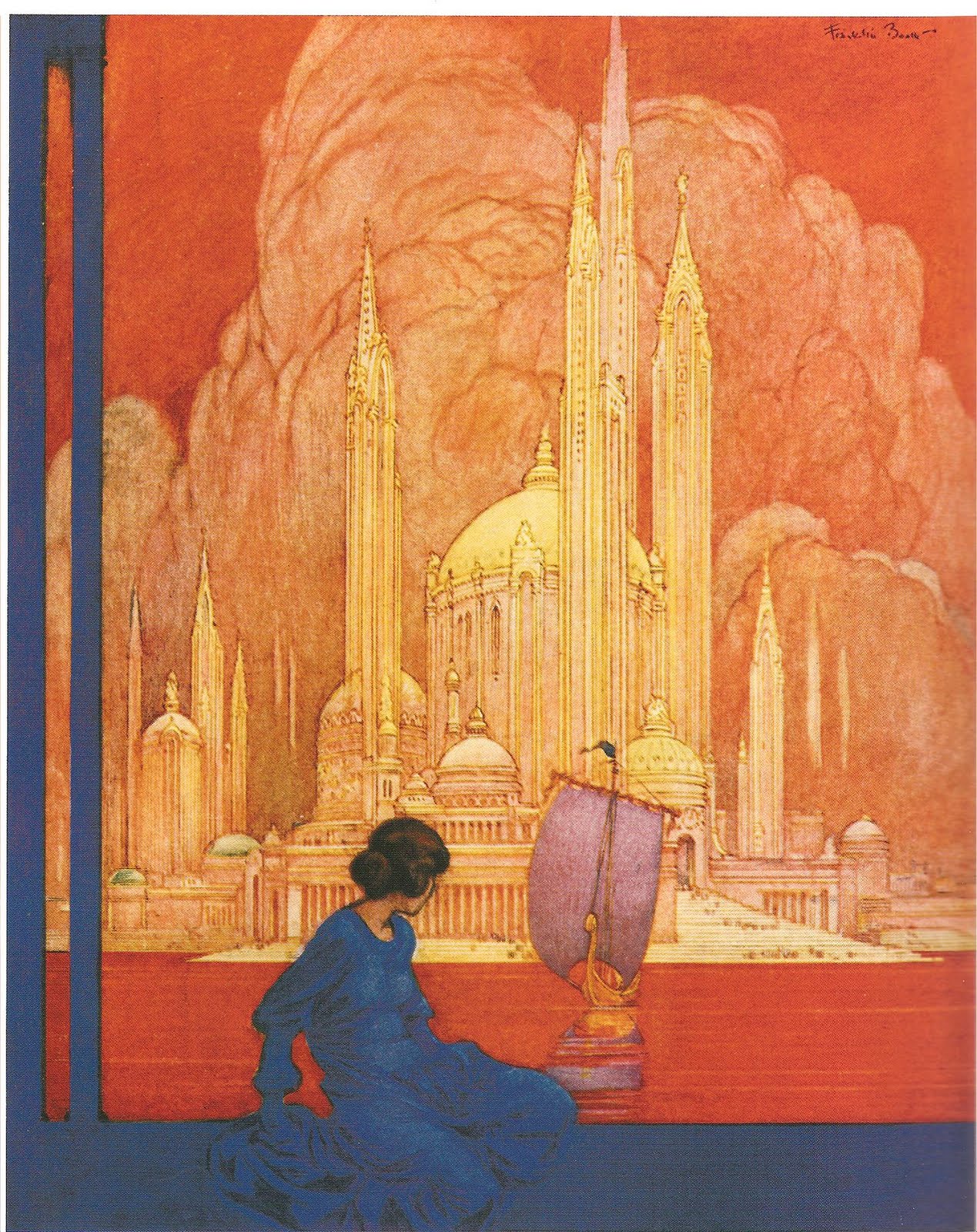
Traces, the magazine of the Indiana Historical Society, has just printed an article on the life and work of Franklin Booth, perhaps the most accomplished of Indiana's illustrators and brother of Hanson Booth, subject of the previous posting. The article is called "Billowing Clouds, Towering Timbers," and it was written by Thomas E. Rugh. Rather than compete with Mr. Rugh's article, I will offer some artwork by Booth. You can read more about him in Traces for Spring 2011.

Franklin Booth was renowned for his technique with a pen, but as this illustration shows, he was every bit as fluent in the language of color. Fantasy illustrator Roy Krenkel (1918-1983) appears to have owed much to his predecessor.
Booth was largely self-taught as an artist. In his naivete as to how black-and-white illustrations were reproduced, he believed they were drawn by hand, so he painstakingly copied the technique of the engraver. In his maturity as an artist, the results were stunning, as this illustration can only suggest.
Franklin Booth was also a cartoonist, though perhaps just once. His "Uncle Charlie Returns to the Farm," a Sunday newspaper comic strip, dates from 1904.

Text and captions copyright 2011, 2024 Terence E. Hanley

Thursday, June 9, 2011

Hanson Booth (1886-1944)

In life and since his death, Hanson Booth has been overshadowed by his older brother, Franklin Booth, a prodigious talent with an inimitable technique. Rather than compete with his brother, Hanson Booth chose different media and different markets and met with no small success himself.

Hanson Booth was born on May 19, 1886, near Noblesville, Indiana, one of a large brood reared by John T. and Susan Wright Booth. Although their father did not always understand the artistic impulse, the Booth children were encouraged in their art by their mother. Largely self-taught as an artist, Franklin Booth was something of a late bloomer and wasn't published until he was in his mid twenties (in the Indianapolis News). Hanson Booth took a different path. He attended Indiana University and was illustrator and cartoonist for the yearbook, The Arbutus, in 1903-1904. Next came studies at the Chicago Art Institute under John Vanderpoel and C.F. Browne in 1905, and the Art Students League under George Bridgman in 1907. That same year, Booth began his career as a magazine illustrator. His older brother had already blazed a trail to New York City. The two men alternated between there and home for many years, sharing a studio in New York and an add-on to the Booth house in Indiana.

Hanson Booth's list of magazine clients is long and impressive: The American Magazine, The Century, The Delineator, Everybody's Magazine, Harper's, Home, Pictorial Review, The Reader, Red Book, Scribner's, and Woman's World. He also illustrated many books, including Find the Woman by Gellett Burgess (1911), The Jack-Knife Man by Ellis Parker Butler (1913), Almanzar by Frank J. Davis (1918), and Renfrew in the Valley of Vanished Men by Laurie York Erskine (1936). Franklin Booth carved out a place for himself as a master of pen and ink. By choice or necessity, Hanson Booth worked in pencil and charcoal. The Indianapolis Star praised his work for its rich tonal quality and suggestion of painterly depth.

With America's entry into the First World War, Hanson Booth enlisted as a private and saw combat at Aisne-Meuse, Guise-Aisne, and Meuse Argonne in France. He also served in occupied Germany after the war, advancing to the rank of lieutenant. He was active in veteran's organizations after the war and was also a member of the Salmagundi Club and the Society of Illustrators. In 1920, Booth built a large stone house on thirty-five acres in Woodstock, New York, an artist's colony that would eventually include Indiana artists Henry Maust and John Striebel. In later years, Booth's output declined as illness advanced. He died on February 26, 1944, near Woodstock. His older brother Franklin survived him by four years.


Text and captions copyright 2011, 2024 Terence E. Hanley

Saturday, June 4, 2011

Macowin Tuttle (1861-1935)

Charles Macowin Tuttle was a painter, illustrator, engraver, teacher, writer, and lecturer who lived a full life as an artist. He was born on November 3, 1861, in Muncie, Indiana, and studied under William Merritt Chase and Frank Duveneck in his home country and under Jean Paul Laurens at the Académie Julien in France. His specialty was wood engraving for which he invented a process himself.

Facts on Tuttle's life are scarce. He was a member of the artist's colony at Colebrook, Connecticut, and of the Salmagundi Club, the National Arts Club, and the American Art Association of Paris. The Salmagundi Club established the Macowin Tuttle Memorial Award in his honor. Tuttle's art is in the collections of Corcoran Gallery of Art, the National Gallery of Art, the Library of Congress, and Yale University. The only reference I have found to his illustrations is to a series of woodcuts depicting a meeting of Herbert Hoover and British Prime Minister Ramsay MacDonald at the president's retreat in Rapidan, Virginia.

Macowin Tuttle died in 1935 in Bucks Hill Falls, Pennsylvania.

"Bingham Hall, Old Campus, Yale University" (1920), a wood engraving by Indiana illustrator Macowin Tuttle.
"Winter in Pennsylvania," an oil painting by Macowin Tuttle.

Text and captions copyright 2011, 2024 Terence E. Hanley

Wednesday, May 18, 2011

Albert A. Matzke (1881-1947)

Part Two
Sometime between September 1918 and January 1920, Albert Adolph Matzke entered Manhattan State Hospital, a psychiatric facility located on Wards Island, between Manhattan and Queens. He was in his late thirties and recently divorced at the time of his hospitalization. The enumerator of the federal census entered his name in her big book on January 9, 1920, alongside dozens of other patients. Three days earlier, Matzke's ex-wife, Prudence Gruelle, was counted along with her family in Norwalk, Connecticut. She had remarried sometime in the late 1910s. Her new husband, Leonard Barton Brown, worked in a hat factory, and her young daughter Peggy was almost three years old. If anyone today knows what happened in the Gruelle family at the time, they haven't said. In any case, Albert Matzke and Prudence Gruelle had gone their separate ways.

Matzke may have returned to the outside world sometime in the early 1920s. His illustrations appeared again in magazines--Everybody's, Metropolitan, and Scribner's--between 1921 and 1923. He also remarried, not once but twice. One of his marriages came and went: on April 28, 1928, a notice in the Indianapolis Star stated that Matzke had filed for divorce from his wife, Odette M.B. Matzke. Later that year, in October 1928, he made a trip from New York to London on board the S.S. American Trader. Whatever the purpose of his trip, he returned stateside with a new wife, young Gladys M. Adams, whom he had married in Kensington in early 1929. By 1930, Matzke had returned to his hometown, Indianapolis, where he kept his own studio and lived with his wife, their young son, and his mother, Mary, who died in 1937. (Her husband, Julius Matzke, had died in 1926.) By the early 1940s, Matzke had become the owner and manager of an apartment house in Indianapolis.

Albert A. Matzke died on November 16, 1947, in Indianapolis. His family is buried at Crown Hill Cemetery, but Matzke is not. In 1959, Matzke's widow, Gladys Matzke, funded the Albert Matzke Painting Studio at the Emison Art Center at DePauw University in Greencastle, Indiana. That studio is no longer in existence. Gladys M. Adams Matzke Chatt died on December 30, 2002, in Wilmington, North Carolina. Her life had encompassed almost the entire twentieth century.

People bored by history and biography are bored by places, dates, and names, all the minutiae spooned out by uninspired teachers and dry, dusty text books. They mistake the yellowed scraps and worn artifacts of the past for living, breathing history. Unfortunately, those scraps are too often all that's left of the real and immediate passions, pleasures, and pains of past lives. And so we reconstruct what we can.

Long before Marilyn Monroe and The Seven Year Itch, women's skirts were lifted by updrafts. Like many cartoons of the day, Matzke's has two parts: an accomplished drawing and a mild pun for a gag.
Another drawing by Indiana illustrator Albert Matzke. Both are from Judge, circa 1910, happier days for the young artist.


Update (Apr. 12, 2016): Albert Matzke and Prudence Gruelle together, from an item in the Indianapolis News, February 27, 1915, page 19. So Matzke was also a violinist.

Text and captions copyright 2011, 2024 Terence E. Hanley

Monday, May 16, 2011

Albert A. Matzke (1881-1947)

Part One
Illustrator Albert A. Matzke married into one of the most prominent families in the history of Indiana art, yet after a promising start, he disappeared from view. The family were the Gruelles and they were painters, illustrators, cartoonists, and makers of Raggedy Ann and Andy dolls, books, and merchandise. The patriarch of the Gruelle family was Richard Buckner Gruelle (1851-1914), a member of the renowned Hoosier Group that included T.C. Steele, J. Ottis Adams, William Forsyth, and Otto Stark. Gruelle and his wife, Alice Benton Gruelle, had three children, artists all. Johnny Gruelle (1880-1938) was of course the creator of Raggedy Ann and Andy. He was also a cartoonist, illustrator, and painter, as was his younger brother Justin Gruelle (1889-1978). Prudence Gruelle (1884-1966) shared in the family's talent for art, but she was also a singer and won scholarships to the Grand Conservatory of Music and the Metropolitan Opera in New York City. She sang for a time with the Aborn Opera Company, but sometime around 1910 she went on the vaudeville circuit as "Prudence Grue, The Singing Cartoonist." She was on hand in 1910 when the Gruelle family purchased a piece of property in Silvermine, Connecticut. That property included an old mill they would use as their studio. One of the artists who would share that studio was Albert Matzke.

Albert Adolph Matzke was born on August 8, 1881, in Indianapolis and attended the new Manual Training High School as the nineteenth century came to a close. He studied art under Otto Stark and Richard B. Gruelle and was already an illustrator for an Indianapolis newspaper at age eighteen. Sometime around the turn of the century, Matzke set off for New York and its Art Students League, where his teachers included Frank V. Dumond and George Bridgman. As early as 1903 and as late as 1907, Matzke was a member of the faculty at the Art Students League. As an illustrator, he contributed to Judge and other magazines of the early twentieth century. He also illustrated a number of books during the 1910s. At the outset of World War I, he was teaching high school and illustrating magazines for the Crowell Publishing Company in New York, publishers of Woman's Home Companion and The American Magazine. And then he seems to have disappeared.

Biographers of the Gruelle family have almost nothing to say about Albert Matzke. They have only a little more to say about his wife, Prudence Gruelle. Although both came from Indiana, they also both studied in New York, and both were members of the thriving art colony at Silvermine. Yet there isn't any mention of how or where they met or of when or where they were married. By 1910, Prudence Gruelle was sharing a home (in Manhattan) and a last name with Albert Matzke. Within a decade they were divorced. By 1920, Prudence was remarried (to a man named Leonard Barton Brown) and had a two-year-old-daughter. And Albert Matzke? He dropped out of sight. Only recently did I find out where he went.

To be concluded . . .

Albert Matzke's frontispiece for The Woman of Mystery (1916) by Maurice Leblanc. This is one of several books illustrated by Matzke between 1915 and 1917--before he disappeared from view. 
Matzke's wife, Prudence Gruelle, was something of a mystery herself. Though known on the vaudeville stage as "Prudence Grue, The Singing Cartoonist," she was trained as a singer of opera and classical music. In 1912, her remarkable profile was displayed on the cover of the sheet music for "In Dixie Land with Dixie Lou." The decorations on the cover are by an artist named Starmer. 

Text and captions copyright 2011, 2024 Terence E. Hanley

Friday, May 6, 2011

Arthur Sinclair Covey (1877-1960)

Arthur Sinclair Covey was born on June 13, 1877, in Leroy, Illinois, and was reared in Missouri and in El Dorado, Kansas. In 1893, Covey "made the run" with the opening of the Cherokee Strip in Oklahoma. He followed up a year at Southwestern College in Winfield, Kansas, with art studies in Chicago, Paris, and Munich between 1897 and 1908.

Living in Indianapolis at the turn of the century, Covey drew pictures for the Indianapolis Press before moving on to the Cleveland Plain Dealer in 1901. He provided illustrations for magazines, including a series of covers for The American Magazine, during the early part of the century, but he found his life's work in painting murals. His first individual commission was for the Wichita Public Library in 1914. Perhaps his best known series is at the Kohler Company offices in Kohler, Wisconsin. That series, completed in 1921-1922, is the subject of a fine article in the Wisconsin Magazine of History, Winter 2009-2010.

Covey married artists in succession. His first wife, Mary Dorothea Sale (d. 1917), was a British citizen and a student of Frank Brangwyn in London, as Covey himself was between 1905 and 1908. In 1921, Covey married Lois Lenski (1893-1974), a children's book author and illustrator famous for her Mr. Small series. In 1928, the couple bought an eighteenth-century house in Harwinton, Connecticut. Called "Greenacres," it would be their home for the rest of Arthur S. Covey's life. One of his last major works was the ceiling of the Trinity Lutheran Church in Worcester, Massachusetts, executed in 1951 when he was seventy-four years old. Covey died nearly a decade later, on February 5, 1960.

"The Run," a lithograph by Arthur Sinclair Covey showing the run on the Cherokee Strip in Oklahoma, 1893, in which the artist took part.
"Work," an etching by Covey which appeared in the Sunday Magazine of the Sunday Star, Washington, D.C., August 31, 1913.
A drawing by Covey on the subject of work. It may be a study for a mural, but I don't know the date of the drawing.
Covey's second wife was author and illustrator Lois Lenski. Every child who grew up between the 1930s and the 1970s remembers her Mr. Small series, of which there were ten titles. Policeman Small (1962) was the last.

Text and captions copyright 2011, 2024 Terence E. Hanley