Tuesday, April 12, 2011

The Civil War

At 4:30 in the morning, on April 12, 1861--one hundred and fifty years ago today--Confederate artillery commenced its bombardment of Fort Sumter at Charleston, South Carolina. Thirty-three hours later, the Union garrison at the fort surrendered. The next day, April 15, 1861--four years to the day before he died from an assassin's bullet--President Abraham Lincoln issued a call for 75,000 troops to put down the insurrection. Thus was ushered in our great Civil War, perhaps the most profound event in American history.

In 1861, Indiana was in its forty-fifth year as a state. Its population was 1,350,428, fifth among the states. Initially, Indiana planned on filling the ranks of six regiments, about 4,600 men in all. Lew Wallace, a veteran of the Mexican war, was to serve as adjutant general and was charged with raising the needed number. So many men answered the call that some had to be turned away. By the end of the war, though, 197,141 Hoosiers had served in the Union cause, second among the states. Another 100,000 filled the ranks of the state militia. Over 25,000 of these men lost their lives. Not counted among that number is the nation's commander-in-chief, who--though he was born in Kentucky and elected from Illinois--spent his formative years in what is now Spencer County, Indiana.

The men who went to war came from all walks of life, art included. Some drew and painted scenes in their own diaries, letters, and sketchbooks. Others created works for publication. Lew Wallace (1827-1905) of Brookville and Crawfordsville was--in addition to being a lawyer, military officer, governor of New Mexico, minister to the Ottoman Empire, and author of the best-selling American novel of the nineteenth century--an artist and illustrator. James Farrington Gookins (1840-1904) of Terre Haute and Indianapolis, who served with Wallace for a time, drew sketches for woodcuts published in Harper's. And Adolph G. Metzner (1834-1918) of Indianapolis kept a sketchbook of the things he witnessed during his war years. (I have written about him in a previous entry, and his work is subject of a newly published book.) Countless artists who came after them have depicted scenes of the Civil War. In any case, we commemorate the men and women who served and died during those four years that rent a nation and the century and a half since that have mended it.


The weekly newspaper was a fairly new thing in America when the Civil War began. Rapid communication by telegraph and rapid transport by train allowed publishers to stay on top of current events and to get the news out to a nation of readers in pretty short order. Photography could not yet be reproduced in the mass media. Instead, newspapers and magazines relied on line art, cut on blocks of wood and assembled into printing plates. Most woodcuts were the work of two artists, the sketch artist who submitted his work from the field and the engraver who transferred the sketch to wooden blocks, worked in a painstaking way for the production of the final image. 

Above is a woodcut from the June 22, 1861, issue of Harper's Weekly, captioned: "The Eleventh Indiana Volunteers Swearing to Remember Buena Vista, at Indianapolis, May, 1861--Sketched by Mr. James F. Gookins." Gookins was a Hoosier, a mostly self-taught artist, and a student of law at Wabash College when war broke out. He served for a time with Lew Wallace and the Eleventh Indiana Volunteer Regiment, a unit of Zouaves which saw service very early in the war. The story accompanying Gookins' drawing in Harper's:

Remember Buena Vista
On page 388 we publish a picture of a most striking scene, which occurred at Indianapolis, in the inclosure [sic] surrounding the State Capitol, a few days since. The artist from whose sketch our picture was made, Mr. James F. Gookins, of Company I, 11th Regiment Indiana Volunteers (Zouaves), writes us as follows concerning it:

The Regiment was presented by the ladies of Indiana with a splendid stand of colors, after receiving which the whole Regiment, kneeling, with uplifted right hands, took an oath before God that, with His help, they would not only avenge themselves of the insults cast at the flag of the nation, but furthermore of the contumely and wrong received by the Indiana troops at the hands of Jeff Davis during the war with Mexico. To keep this oath more continually before them they have adopted the motto "Remember Buena Vista!" as their warcry.

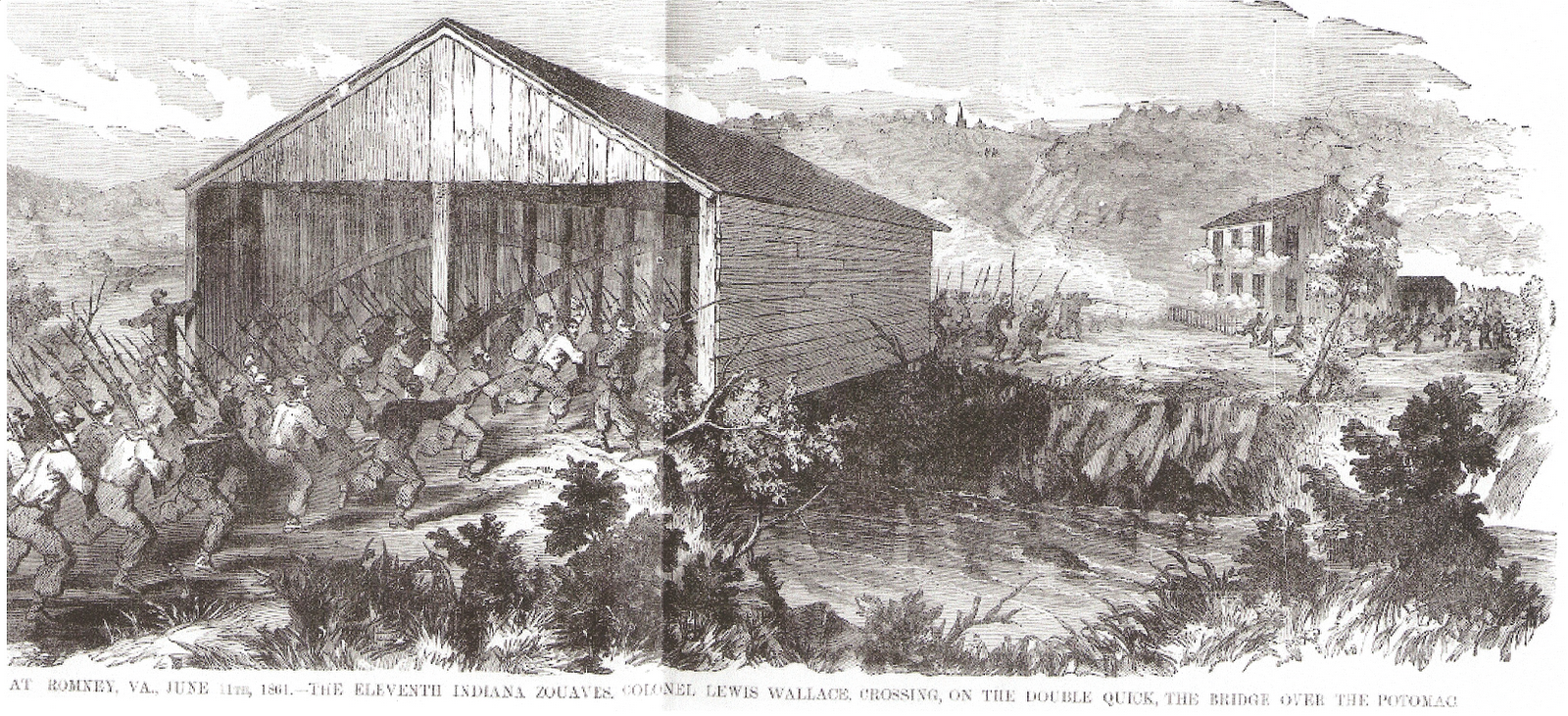
Another image from Harper's. The caption reads: "At Romney, Va., June 11th, 1861,--The Eleventh Indiana Zouaves, Colonel Lewis Wallace, crossing, on the double quick, the bridge over the Potomac." The artist is unknown.
The story of the Civil War is of course incomplete without Abe Lincoln. His election to the presidency was--in the minds of the secessionists--the event that precipitated the South's withdrawal from the Union. Even then, a legend had begun to build about him and his life. John T. McCutcheon (1870-1949) drew from that legend, just as so many cartoonists  have, before and since. From John McCutcheon's Book.
As a child, Franklin Booth (1874-1948) learned to draw by imitating woodcut illustrations from books and other publications. By the time Booth began working professionally as an artist, Abraham Lincoln had reached the status of an icon in American art, history, and popular imagination. This drawing, though it has the appearance of a woodcut, was actually done with a pen. It's a decoration for an unknown use. Like Lincoln, Booth grew up on an Indiana farm, in the artist's case, in Hamilton County, northeast of Indianapolis. He was perhaps the most accomplished Indiana illustrator of his time. His drawing of Lincoln here only hints at his really astonishing technique and enormous body of work.   

There are of course other illustrations by Indiana artists on the topic of the Civil War. Unfortunately, many of them are protected from usage on the Internet. If anyone has pictures to offer, please send them to me at:


Text and captions copyright 2011, 2024 by Terence E. Hanley

Thursday, March 31, 2011

Clotilde Embree Funk (1893-1991)

In observance of National Women's History Month, Indiana Illustrators presents an entry on a woman who not only illustrated books on history, but also lived a fair bit of it herself during her near century on earth.

Clotilde Embree Funk was born on June 25, 1893, in Princeton, Indiana, to a pioneer family of Huguenot origin. After attending local schools in Princeton, she set off for the Tudor School and the Herron School of Art in Indianapolis, where she studied from 1911 to 1913. Her art career began in earnest when she moved to New York City in 1917 to live with her older sister Louise. Clotilde studied at the Cooper Union Art School (1917-1920) and worked as a freelance commercial artist, while Louise labored away as a fifteen-dollar-a-week fashion editor.

The two advanced their careers over the next decade, and by the early 1930s, change was in the works for both. Louise Embree wrote a biography of George Washington and submitted it to a New York publisher, accompanied by younger sister Clotilde’s sketches. In rapid order, Clotilde Embree married Claude Douglas Funk (a man she had known since third grade) while on vacation in her hometown of Princeton, the book was accepted, and Clotilde spent her honeymoon working on her illustrations. In 1931, she settled in Indianapolis to raise a family, and the following year, A Child’s Life of George Washington by Louise Embree came out. Clotilde Embree was off on a new career.

Over the next three decades, Clotilde illustrated more than sixty children's books. She drew the pictures for some of the first in the "Childhood of Famous Americans" series published by the Bobbs-Merrill Company of Indianapolis. The illustrations for biographies of George Washington, Abraham Lincoln, Thomas Jefferson, Robert E. Lee, and George Washington Carver (all by Augusta Stevenson) and Stephen Foster (by Helen Higgins) were hers. Clotilde's other books included Cecilia’s Locket and her own favorite, To See the Queen (1954)

An injury to her wrist forced Clotilde to give up illustration in favor of painting in 1962. She studied under Martha Slaymaker, whom she called "the biggest influence on my later work." Thereafter, she exhibited in Indianapolis and elsewhere and won several prizes for her work.

Clotilde Embree Funk died at age ninety-eight on November 10, 1991, in Noblesville, Indiana. She was a small woman with a great talent, and she loved children and drawing children.


Early in her career, Clotilde Embree Funk worked in silhouette, a seemingly simple form. However, the use of three silhouettes on this cover, each of a different color and depth, adds a level of sophistication.
To See the Queen (1954) was Clotilde's favorite among her books. Not long ago, I found a copy of her book at an antique mall. Now I can present the front and back covers and the full effect of Clotilde's drawing.

Text and captions copyright 2011, 2024 by Terence E. Hanley

Wednesday, March 9, 2011

Adolph G. Metzner (1834-1918)

The most recent issue of Traces of Indiana and Midwestern History (Winter 2011), the magazine of the Indiana Historical Society, features an article about Adolph G. Metzner, a German-born artist who served on the side of the Union during the Civil War. The cover and most of the contents of this issue commemorate the sesquicentennial of Indiana's involvement in the Civil War.

Born in 1834, Metzner enlisted in Indianapolis in 1861 and served in Kentucky, Tennessee, and Georgia. Along the way, he drew and painted pictures of what he witnessed. Traces displays several pieces of artwork in full color, from a burlesque camp scene to one of the most gruesome images I have ever seen published in an American magazine. The images are drawn from the same sources used in the publication of a book called Blood Shed in This War: Civil War Illustrations by Captain Adolph Metzner, 32nd Indiana by the author of the article in Traces, Michael A. Peake.

Metzner returned to Indianapolis after the war and worked as a pharmacist. He later gave up pharmacy for research and industry in the field of ceramics. He died in New Jersey in 1918 but is buried at Crown Hill Cemetery in Indianapolis.

The name of the article, by the way, is "Adolph G. Metzner: Entrepreneur, Soldier, and Artist." And rather than steal any thunder from the book, the magazine, the article, or the author, I will simply refer you to them, each one as you like.

Copyright 2015, 2024 Terence E. Hanley

Tuesday, March 8, 2011

Lucy Fitch Perkins (1865-1937)

Today, March 8, 2011, is International Women's Day, and the centennial year of the first International Women's Day. This year is also the centennial year for the publication of a book called The Dutch Twins by Indiana author and illustrator Lucy Fitch Perkins. Although Lucy Fitch Perkins had previously written and illustrated two books, The Dutch Twins was her first based on a pair of ideas which had recently impressed the author. In her words:
One was the necessity for mutual respect and understanding between people of different nationalities if we are ever to live in peace. . . . The other . . . that a really big theme can be comprehended by children if it is presented in a way that holds their interest and engages their sympathies.
The Dutch Twins was the first in a series that eventually totaled twenty-seven titles, from The Cave Twins (1916), to The Spartan Twins (1918), to books about twins from Ireland, Mexico, Switzerland, France, the Philippines, Italy, and many other nations and periods of history. I think a remembrance of Lucy Fitch Perkins and her work is just right for today's occasion.

Lucy Adeline Fitch Perkins, descended from passengers of the Mayflower, was born on July 12, 1865, in the little town of Maples, Indiana. Her formal instruction in art came at the School of Boston Museum of Fine Arts from 1884 to 1888 under Robert Vannoh, Otto Grundman, and Frederic Crowninshield. After a year of work for the Prang Educational Company, Fitch moved to Brooklyn, where she taught art at the newly established Pratt Institute. At the end of "four happy winters teaching and studying" (1887-1891), Fitch married architect Dwight Heald Perkins (1867-1941), whom she had met in Boston. The newly wed couple returned to the Midwest, to Evanston, Illinois, where she spent most of the rest of her life and where she bore two children.

Lucy Fitch Perkins was a prolific author and illustrator of children's books. During her forty-year career, she wrote and illustrated nearly four dozen books. Her first book (illustrations only) was Fairy Starlight and the Dolls, published in 1896. The Goose Girl: A Mother's Lap Book of Rhymes and Pictures (1906) and A Book of Joys: The Story of a New England Summer (1907) were her own, words and pictures all. In 1911, she hit on a winning formula with The Dutch Twins. Nearly every year for the rest of her life, Lucy Fitch Perkins wrote and illustrated a new book, mostly about twins. In 1935, her two-millionth copy rolled off the printing press, a testament to the sureness of her vision of three decades before. The last twins book, The Dutch Twins and Little Brother (1938), was published posthumously, for Lucy Fitch Perkins died on March 18, 1937, in Pasadena, California.

In the following pictures, you can see the artist's fine handling of the human form and of design and color. There is of course an art nouveau influence. Some of these pictures are also quite like the poster designs of the day. In any case, you will see that Lucy Fitch Perkins, like so many women artists, then and now, drew and painted women and children with real delicacy, warmth, and affection. The last image may not be quite right for today's observance, but I couldn't pass up the chance to show it, as striking and dramatic as it is.


Text copyright 2011, 2024 by Terence E. Hanley

Saturday, February 26, 2011

Robert K. Abbett (1926-2015)

Robert Kennedy Abbett was born in Hammond, Indiana, on January 5, 1926, to Clarence C. and Vere (Kennedy) Abbett. He studied nights at the Chicago Academy of Fine Art and graduated from Purdue University and the University of Missouri. Bob Abbett served in the U.S. Navy during World War II.

Abbett wrote for a public relations firm in Chicago before embarking on a career as an artist, working in succession for a number of art studios. His first magazine illustrations were for Extension magazine. Abbett's list of freelance clients during the 1950s and '60s includes Argosy, Reader's Digest, Redbook, Sports Afield, This Week, and True, as well as Ballantine, Bantam, Dell, Fawcett, Pocket, Pyramid, and Signet books.

Bob Abbett left illustration behind in the 1970s, afterwards devoting himself to painting pictures of outdoor sporting scenes, hunting dogs, game animals, and similar subjects. He was also a portraitist, a teacher, and magazine columnist. He lived at his own Oakdale Farm in Connecticut for many years and died at home in Bridgewater, Connecticut, on June 20, 2015. He was eighty-nine years old.

You can read more about Bob Abbett at his official website, Oakdale Prints, here, and on a recent blog entry at a blog called Today's Inspiration by Leif Peng, here. A Google Image search will show a variety of Mr. Abbett's many fine paperback cover illustrations from the 1960s. Below is a small sampling from my own library.


Revised and updated on December 6, 2019.
Text copyright 2011, 2024 by Terence E. Hanley

Wednesday, February 16, 2011

Henry Jackson Lewis (ca. 1837-1891)

Henry Jackson Lewis is considered the first black political cartoonist in the United States. He was born a slave in either 1837 or 1838 (according to his son, Chester Arthur Lewis) in or near Water Valley, Mississippi, not far south of Oxford. He taught himself to read, write, and draw, overcoming not only his beginnings in bondage but also a childhood accident in which he fell into a fire, leaving him crippled in his left hand and blind in his left eye.

Lewis' story does not pick up again until 1872 when he purchased a lot in Pine Bluff, Arkansas, at about the same time he married Lavinia Dixon. Chester Arthur Lewis was the last survivor of the Lewises' seven children, and it is by way of a tape-recorded interview with him that we know much of what we know about his artist father. The younger Lewis also donated some of his father's artwork to the Du Sable Museum of African-American History in Chicago.

Lewis got his start as an artist by sketching for Harper's Weekly during the late 1870s. His skills as a topographical and architectural draftsman helped secure him work with the Smithsonian Institution under Edward Palmer and his Indian Mound Survey. The original drawings for the project are in the collection of the Smithsonian’s National Anthropological Archives. Still other engravings based on Lewis’ drawings were published in Frank Leslie's Illustrated Newspaper in April and May of 1883.

Around 1885, Lewis found employment as a porter at the Arkansas Gazette and learned something about the newspaper trade by watching staff artists and engravers at work. In late 1888 or early 1889, he relocated to Indianapolis, recruited by editor Edward Elder Cooper of The Freeman, a black newspaper billed by its publisher as "The Harper’s Weekly of the Colored Race" and "A National Illustrated Colored Newspaper." Targets of his cartoons included racist policies and expressions, but Cooper and Jackson waged their harshest campaign against the Republican administration of President Benjamin Harrison (who was, incidentally, also from Indianapolis).

Lewis' last drawing appeared in the March 28, 1891, issue of The Freeman. Less than two weeks later, on April 9, 1891, he died in Indianapolis. His family remained in Indianapolis. John W. Lewis, the oldest Lewis child, became an artist himself and drew for The Freeman, The Indianapolis World, and The Indianapolis Recorder.


Henry Jackson Lewis--the first known black political cartoonist in the United States. This is a self-portrait from the Indianapolis-based
Freeman. Note that Jackson is turned to his left: a childhood accident left him blind in his left eye.


One of Lewis' drawings of Indian mounds, this one at Walnut Lake Station, Arkansas.


Finally, a pair of Lewis' political cartoons, from The Freeman, June 2, 1889.
a
An entry in observance of Black History Month.
Text and captions copyright 2011, 2024 by Terence E. Hanley

Friday, February 11, 2011

Egypt

Without trivializing what the people of Egypt have accomplished, Indiana Illustrators offers an entry on Egypt, with images by Indiana artists.

An advertisement for Caterpillar Tractors by Junius S. Cravens (1883-1936).
A striking illustration for a short story, perhaps from Cosmopolitan, by Walter S. Louderback (1887-1941).
A.R. Tilburne (1887-1965) illustrated several covers for Weird Tales.  Animals were a specialty.
Another Tilburne cover for Weird Tales.
Hugh Rankin (1878-1956) preceded Tilburne as a cover artist for Weird Tales.
Finally, another Rankin cover for Weird Tales.

And an artist whose work, inspired by Egypt, seems to be unavailable on the Internet, despite its prominence: Helen Eaton Jacoby (1888-1967), born and educated in Indianapolis, designed a series of friezes with an Egyptian theme for the Murat Shrine Temple in her hometown sometime before World War II. Unfortunately, I have not been able to find any images of her work. If anyone has access to them, please send them my way. Best wishes to the people of Egypt and throughout the Middle East in their efforts to bring democracy and prosperity to their region.

Text and captions copyright 2011, 2024 by Terence E. Hanley